

Short answer. Washington eviction laws require a landlord to have one of the legal reasons listed in RCW 59.18.650, serve the matching written notice, and win a court order. Only the sheriff can remove a tenant.
For unpaid rent, that means a 14-day pay-or-vacate notice, a show cause hearing set 7 to 30 days after the court’s order is served, and a sheriff’s notice of at least 3 days.
Since 2021 there is no such thing as a no-cause eviction for most tenancies. Since June 2026, the rules for serving notices have changed too.
If you’re reading this, something may already have gone wrong: rent is late, a lease is being broken, or you need the unit back. This guide walks through the Washington eviction process in the order you’ll meet it, with the statute behind each step, so you can plan before you act.
General information, not legal advice. Washington law changes, and eviction cases turn on facts. Talk to a landlord-tenant attorney before serving a notice or filing.
Washington Eviction Notices at a Glance
Every eviction in Washington starts with a reason and the notice that goes with it. These are the main ones:
| Reason for ending the tenancy | Minimum notice | Statute |
|---|---|---|
| Unpaid rent | 14 days to pay or vacate, on the state form | RCW 59.12.030(3), 59.18.057 |
| Breaking a lease term (not money) | 10 days to fix it or vacate | RCW 59.18.650(2)(b) |
| Waste, nuisance, unlawful activity or serious interference with neighbors | 3 days to quit | RCW 59.18.650(2)(c) |
| Sharing a kitchen or bath with the owner; sexual harassment of the owner, staff or another tenant based on a protected status, in violation of the lease | 20 days before the end of the period | RCW 59.18.650(2)(i), (p) |
| Unit condemned as uninhabitable; intentional lie on the application | 30 days | RCW 59.18.650(2)(h), (l) |
| Other legitimate business reason; four or more cured violations in 12 months, with written warnings | 60 days before the end of the period | RCW 59.18.650(2)(m), (n) |
| Owner or immediate family moving in; selling a single-family home | 90 days | RCW 59.18.650(2)(d), (e) |
The statute lists a few more reasons, such as transitional housing ending and a tenant refusing reasonable new lease terms. Read the full list before you pick one.
STEP 1Have a Legal Reason (Washington’s Just Cause Rule)
Since 2021, a Washington landlord can’t simply decline to renew a month-to-month tenancy. A periodic tenancy can end only for one of the causes in RCW 59.18.650(2). A 20-day notice no longer ends a month-to-month tenancy on its own.
Two narrow exceptions let a tenancy end without cause, and both need at least 60 days’ written notice (RCW 59.18.650(1)):
- A first lease of 6 to 12 months. It can end without cause at the end of that first term, if you give notice before the term ends.
- A lease of 12 months or more, or an unbroken chain of leases of six months or more. It can end without cause when it expires, but only if the tenancy has never gone month-to-month.
Outside these two, you need a listed cause.
Owner move-in has teeth. You need 90 days’ notice, and no equivalent unit in the same building can be vacant. The law presumes bad faith if you or your family don’t live there as a principal residence for at least 60 consecutive days within the 90 days after the tenant leaves.
So does selling. You must make reasonable efforts to sell, such as listing the home, within 30 days after the tenant moves out.
Getting it wrong is expensive. A landlord who removes a tenant in violation of the statute owes the greater of the tenant’s damages or three times the monthly rent, plus the tenant’s attorney fees (RCW 59.18.650(4)).
STEP 2Serve the Right Notice, the Right Way
For unpaid rent, use the state form. The 14-day notice must be in substantially the form set out in RCW 59.18.057. It must:
- Itemize what’s owed: rent, utilities and other recurring charges, by month, with a total.
- Say how to pay: where to send payment, and that the tenant can pay as the lease allows or by nonelectronic means, including a cashier’s check, money order or other certified funds.
- List the tenant resources the form requires: the Attorney General’s landlord-tenant page, legal aid lines and dispute resolution centers.
Rent comes first. A landlord must apply every payment to rent before late fees, damages or legal costs. A tenant’s right to stay can’t depend on paying anything other than rent, with narrow exceptions (RCW 59.18.283). You can still collect those other charges, just not by evicting over them.
Serve it correctly. The rules changed in 2026. Under RCW 59.12.040, as amended by HB 2664 (2026 c 144, effective June 11, 2026; final bill report), you can:
- Hand it to the tenant.
- Leave it with someone of suitable age and discretion at the home, if the tenant isn’t there, and also mail a copy to the tenant.
- If no one suitable can be found, post it in a conspicuous place, give a copy to a resident if one can be found, and mail a copy to the tenant at the premises.
The mailed copy no longer has to go by certified mail.
Two things haven’t changed:
Mail adds time. When service relies on mail, the tenant gets five extra days before you can file.
The notice must give a date. Every termination notice must state the date by which the tenant must vacate or comply (RCW 59.12.040). A notice based on a just cause reason must also state the facts known to you in enough detail for the tenant to respond and prepare a defense (RCW 59.18.650(6)).
STEP 3File the Case and Serve the Eviction Summons
If the notice period runs out and nothing is fixed, the next step is an unlawful detainer case in superior court. The filing fee to start the case is $45, plus $90 in surcharges the statute adds, or $135 in all (RCW 36.18.020). Service costs and attorney fees come on top of that.
The tenant is served with an eviction summons in the form set out in RCW 59.18.365. It tells them how to respond and where to find free legal help. The landlord can also ask the court for an order to show cause. That order sets a hearing no less than 7 and no more than 30 days after it’s served (RCW 59.18.370).
The tenant may have a lawyer. Washington courts must appoint an attorney for tenants who are indigent, meaning on certain public benefits or earning at or below 200% of the federal poverty level, subject to state funding (RCW 59.18.640).
STEP 4The Hearing, the Judgment, and the Tenant’s Last Chance
If the landlord wins, the court orders the tenant out and can award unpaid rent and damages (RCW 59.18.410). Three limits matter here.
- Late fees are capped at $75 in total in the judgment. That’s the most a judgment or reinstatement can include, not a monthly cap on late fees in a lease.
- Attorney fees may be off the table. A court can’t award the landlord attorney fees when the rent judgment is no more than two months’ rent or $1,200, whichever is greater. It also can’t award them when the tenant simply didn’t respond (RCW 59.18.290).
- The tenant can still pay and stay. In a nonpayment case, the tenant can reinstate the tenancy by paying everything the judgment requires, before judgment or within five court days after it. A tenant with a written pledge from a government or nonprofit rental assistance program has until the eviction date.
You must accept rental assistance. Before the 14-day notice expires, you must accept an emergency rental assistance pledge that covers the full rent owed. After it expires, you must accept a written pledge that contributes to the total, and pause the court case for 14 court days once you’ve provided your payment information (RCW 59.18.410(2)).
The court can also pause the eviction. After a nonpayment judgment, a judge may stay the writ for up to 90 days on a payment plan, after weighing factors such as hardship and payment history. A tenant served with three or more pay-or-vacate notices in the past 12 months generally can’t ask for this relief (RCW 59.18.410(3)).
STEP 5The Writ and the Sheriff
Only the sheriff can remove a tenant. Once the court issues a writ of restitution, the sheriff serves it, and must then wait three days before carrying it out (RCW 59.18.390).
Be careful with money at this stage. Accepting a partial payment doesn’t cancel the writ unless both sides sign a written agreement, and a copy reaches the sheriff.
Belongings left behind have their own rules. After the sheriff restores possession, the tenant’s property is governed by RCW 59.18.312:
- Storage on request: if the tenant asks in writing within 3 days of the writ being served, you must store it. Without a request, you may store it unless the tenant objects. If the tenant objects, or you decide not to store it, it goes on the nearest public property.
- Notice before sale or disposal: you must give written notice first. That’s 30 days for property worth more than $250, and 7 days for $250 or less.
- Keepsakes are protected: personal papers, family pictures and keepsakes can’t be sold or thrown out under the $250 rule.
Once the tenant is out, the deposit rules still apply too: send a full and specific statement within 30 days (RCW 59.18.280).
Never take matters into your own hands, at any stage.
Removing a tenant or locking them out without a court order is illegal, and the tenant can recover possession or end the lease, plus damages and attorney fees (RCW 59.18.290). Intentionally shutting off utilities exposes you to actual damages plus up to $100 for each day without service (RCW 59.18.300).
How Long Does the Eviction Process Take in Washington State?
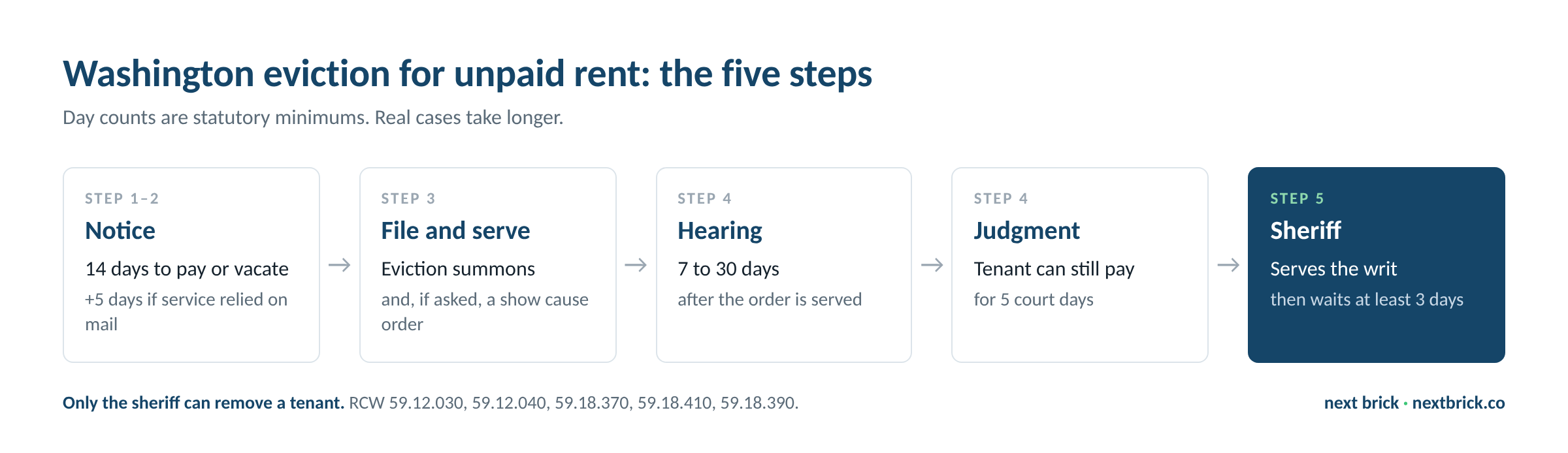
Add up the statutory minimums for unpaid rent and you get roughly a month:
- Notice: 14 days, plus 5 if service relied on mail.
- Hearing: if you ask for a show cause order, at least 7 days after it’s served.
- Judgment: the tenant has five court days to pay and stay, and the sheriff can’t carry out the writ before then.
- Sheriff: three days after serving the writ.
Real cases run longer. Serving papers, court calendars and sheriff scheduling all add time, and a rental-assistance pledge or a court-ordered payment plan can pause things for weeks or up to 90 days. Plan around the longer number. In Seattle, local rules can push the end date into spring or summer for some households. See the City’s defenses to eviction.
Five Washington Eviction Myths Worth Correcting
Search this topic and you’ll find confident answers that no longer match the statutes. Here are five to watch for:
| What you’ll read online | What the statute says |
|---|---|
| “You can end a month-to-month tenancy with 20 days’ notice.” | Not since 2021. Periodic tenancies end only for a listed cause (RCW 59.18.650). |
| “After an owner move-in, you must live there for 12 months.” | The state statute says something different, and some cities add their own rules. Seattle, for example, may require the owner to certify the reason to the City. Under state law, bad faith is presumed if the owner or family doesn’t occupy the unit for at least 60 consecutive days within the 90 days after the tenant leaves. |
| “Late fees are capped at $75 a month.” | The $75 figure is the most an eviction judgment or reinstatement can include in late fees, in total (RCW 59.18.410). It isn’t a monthly cap on late fees in the lease. |
| “A tenant can pay up any time before the sheriff arrives.” | The window is before judgment or within five court days after it. Only a tenant holding a rental-assistance pledge gets until the eviction date. |
| “The notice has to go by certified mail.” | Not since June 11, 2026. Regular mail now works for the mailed copy. The five extra days still apply (RCW 59.12.040). |
Washington State Eviction Laws That Work Alongside the Process
- Retaliation. If you serve a notice or raise the rent within 90 days after a tenant’s good-faith complaint to a government agency, or another lawful exercise of their rights, the law presumes retaliation. You then have to prove otherwise. The presumption flips if the tenant was behind on rent or in breach when you gave notice, and it doesn’t arise for a rent increase whose notice states reasonable grounds (RCW 59.18.250).
- Rent increases. These have their own rules, and an increase within 90 days of a tenant’s complaint can be presumed retaliation unless your notice states reasonable grounds (above).
- Notice and timing: a rent increase needs 90 days’ written notice (RCW 59.18.140). The notice period is 30 days for income-based subsidized rent, and an increase can’t take effect before a fixed term ends. Unless the home is exempt, rent can’t go up in the first 12 months of a tenancy (RCW 59.18.700).
- The cap: after that, increases are capped at 7% plus inflation or 10%, whichever is less, in any 12 months (RCW 59.18.700). The Department of Commerce sets the figure each year: 9.683% for 2026 and 10% for 2027 (Commerce, HB 1217 landlord resource center).
- Exemptions: some homes are exempt, including buildings whose first certificate of occupancy is 12 years old or less (RCW 59.18.710).
- Federal rules. If the property has a federally backed mortgage or takes part in certain federal housing programs, the CARES Act requires 30 days’ notice before a tenant must leave for nonpayment (15 U.S.C. § 9058(c); Housing Authority of King County v. Knight, Wash. 2025). The Fair Housing Act applies at every step, including who you screen, warn and evict (42 U.S.C. § 3604).
Local Rules: Seattle and Other Cities
State law sets the floor, and some cities build on it. If your rental is in one of these cities, read its rules too:
- Seattle. The City has its own just cause rules in SMC chapter 22.205 (SDCI). It also gives some households a defense to eviction between December 1 and March 1, and during the school year. An unregistered rental can also stop an eviction (SDCI, Defenses to Eviction). Our Seattle rental checklist covers registration.
- Kirkland. KMC chapter 7.75 (from Ordinance O-4810, 2022) sets its own rent-increase notice and move-in cost rules (KMC 7.75, current through Ord. 4947, September 2026).
- Bellevue. City code chapter 9.21 requires relocation assistance for low-income tenants who are displaced when the City orders a demolition, substantial rehabilitation or change of use because of code violations. Until those payments are made, the owner can’t evict or pressure those tenants in order to avoid the chapter (BCC 9.21, current through Ord. 6929, July 2026).
- Redmond. RMC chapter 9.54 (Ordinance 3091, 2022) requires longer notice for larger rent increases, caps move-in costs and late fees, and doesn’t add just cause rules (City of Redmond).
- Mercer Island. Ordinance 26C-07 (passed June 16, 2026) adds a citywide rental property license. In multifamily and Town Center zones it also requires two things. First, 120 days’ notice for rent increases above a cumulative 3% in 12 months, on rental agreements that start after it took effect. Second, $2,000 in relocation assistance for low-income tenants displaced by demolition, substantial rehabilitation, change of use or the end of rent restrictions. It doesn’t add just cause rules (Ordinance 26C-07).
- Shoreline. SMC chapter 9.35 (Ordinance 996, 2023) requires 120 days’ notice for rent increases above 3% and 180 days for 10% or more. It caps move-in fees plus deposit at one month’s rent and late fees at 1.5% of rent, and bars any fee for issuing a notice to a tenant. It doesn’t add just cause rules (SMC 9.35).
- Auburn. The just cause section of ACC chapter 5.23 was repealed in 2025 (Ord. 6966). The chapter still requires landlords to give tenants a City resource summary with any notice under RCW 59.12.030. A landlord who doesn’t comply with the chapter gives the tenant a defense in an eviction case (ACC 5.23, current through Ord. 7023, July 2026).
- Kent. Its 2021 notice ordinance (KCC chapter 10.03) has been repealed. Most rentals must be registered before they’re offered for rent and inspected every three years under KCC chapter 10.02 (KCC 10.02).
- Renton. Rentals must be registered each year under RMC 4-5-125. We found no extra eviction rules in Renton’s code (RMC 4-5-125, current through Ord. 6197, August 2026).
We also searched the current codes of Everett, Bothell, Lynnwood, Sammamish and Edmonds on October 12, 2026 and found no local eviction rules beyond state law. Codes change, so check your city’s current code before you serve a notice.
Three Worked Examples
These examples are made up to show how the rules work. They are not real cases.
Example 1: Unpaid rent outside Seattle
The setup: a tenant paying $2,400 a month misses October rent. The owner serves the 14-day form by leaving it with the tenant’s adult roommate and mailing a copy, so the owner must wait out 19 days after service (14 plus 5) before filing.
A partial pledge: on day 10, before the 14-day notice expires, a nonprofit sends a written pledge covering part of the balance. Because the notice hasn’t expired, the owner only has to accept a pledge that covers the full rent owed. From day 15 on, even while the owner waits out the five mail days, the notice has expired. So a pledge that arrives then must be accepted even if it covers only part of the total, and the owner must pause the case for 14 court days after giving payment details.
The fee trap: say the case goes ahead and the judgment is for $4,800 in rent. That’s two months’ rent, so the court can’t award the owner attorney fees. The greater of two months’ rent or $1,200 is $4,800, and the judgment doesn’t exceed it.
Example 2: A pet the lease doesn’t allow
The notice: a tenant moves in a dog against a no-pets clause. The owner serves a 10-day notice to comply or vacate.
If the tenant fixes it: the tenant rehomes the dog within 10 days, and the tenancy continues.
If it keeps happening: a pattern of four or more cured violations in 12 months, each with a proper written warning, can support a 60-day notice under RCW 59.18.650(2)(n).
Example 3: Moving back into your own home
The setup: an owner wants to move back in. The tenant is month-to-month, so the owner serves 90 days’ written notice.
After the tenant leaves: the owner must actually live there. Moving in for a few weeks and then re-renting invites a bad-faith claim. If the tenant wins, you owe the greater of their damages or three times the monthly rent, plus their attorney fees.
If it’s a fixed-term lease: owner move-in can’t end the lease early unless both sides agree in writing and the tenant gets at least 60 days to leave.
What to Do Before You Serve Any Notice
- Name your cause. Match it to a specific subsection of RCW 59.18.650, and make sure the facts support it.
- Use the right notice. Use the right form and the right notice period, and include the date by which the tenant must pay, comply or leave.
- Itemize only what the law allows. For nonpayment, that’s rent, utilities and recurring charges. Collect other fees separately.
- Serve it correctly and record how and when. If you rely on mail, count the five extra days.
- Point the tenant to rental assistance early. Then accept qualifying pledges when they arrive.
- Check your city’s rules. This applies especially in Seattle, Bellevue, Kirkland, Redmond, Mercer Island, Shoreline and Auburn.
- Never lock a tenant out, remove their belongings or cut utilities without a court order. After the writ, follow the storage and notice rules for anything left behind.
- Call an attorney before you file. The tenant may well have one.
If you’d rather not run this process yourself, our eviction support service covers:
- serving the required notices
- starting and pursuing the eviction case
- regaining possession
- recovering unpaid rent and other amounts owed
Careful resident screening and rent collection lower the risk of ever reaching that point, though no screening removes it entirely. For tenants we screen and place, our Eviction Guarantee helps with legal fees when we handle an eviction in the first 12 months of the lease (terms apply). You can see our management pricing before you decide, or read how a property manager can help with an eviction.
Frequently Asked Questions
What are the eviction laws in Washington state?
Washington requires a legal reason from RCW 59.18.650, a written notice that matches it, and a court order. For unpaid rent, that’s a 14-day pay-or-vacate notice on the state form. Only the sheriff can remove a tenant, three days after serving the writ.
Can a landlord evict without cause in Washington?
Not for most tenancies. Since 2021, month-to-month tenancies end only for a listed cause. There are two narrow exceptions, each needing at least 60 days’ written notice. A first lease of 6 to 12 months can end without cause at the end of its first term. A lease of 12 months or more that never went month-to-month can end when it expires.
How much notice does a landlord have to give to evict in Washington?
It depends on the reason: 14 days for unpaid rent, 10 days to fix a lease violation, 3 days for waste or nuisance, and 90 days for owner move-in or the sale of a single-family home. Add five days when service relies on mail.
How long does the eviction process take in Washington State?
The statutory minimums for unpaid rent add up to roughly a month. Real cases take longer, because serving papers, court calendars and sheriff scheduling add time, and a court can stay the writ for up to 90 days on a payment plan.
Can a landlord change the locks to evict a tenant in Washington?
No. Removing or excluding a tenant without a court order is illegal, and intentionally cutting off utilities can cost up to $100 a day plus damages. Only the sheriff can carry out an eviction.
Does an eviction notice have to be sent by certified mail in Washington?
No, not since June 11, 2026. When a notice is left with someone of suitable age and discretion at the home or posted, the mailed copy can go by regular mail. Service by mail still adds five days before you can file.
Can a tenant stop an eviction by paying?
In a nonpayment case, yes. The tenant can pay everything the judgment requires before judgment or within five court days after it. A tenant with a written rental-assistance pledge has until the eviction date.
Can a landlord recover late fees in an eviction judgment?
Only up to $75 in total, and only if the lease provides for them. Payments must go to rent first, and a tenant’s right to stay can’t depend on paying fees other than rent.
Do tenants get a free lawyer in Washington evictions?
Tenants who are indigent, meaning on certain public benefits or at or below 200% of the federal poverty level, are entitled to an appointed attorney, subject to state funding.
Do Seattle landlords have extra eviction rules?
Yes. Seattle has its own just cause rules, defenses for some households in winter and during the school year, and a rental registration requirement that can stop an eviction. Check the City’s guidance before serving a notice.
What is a 14-day pay or vacate notice in Washington State?
It’s the state’s pay-or-vacate notice for unpaid rent. It must follow the state form, itemize rent, utilities and other recurring charges by month, say where to pay, and give the tenant 14 days after service to pay or move out. If service relied on mail, you must wait five more days before filing.
What are the steps in the Washington eviction process?
Have a legal reason, serve the matching written notice, file and serve an eviction summons, win at the hearing, and have the sheriff carry out the writ of restitution. In a nonpayment case, the tenant can still pay and stay until five court days after judgment.
The Bottom Line
Washington eviction laws are a sequence: each step has its own form, deadline and statute. Know your cause, use the right notice, serve it the way the 2026 rules allow, accept rental assistance when it’s offered, and let the court and the sheriff finish the job.
A notice that’s wrong in form, content or service can send you back to the start.
Want help with a tenant situation before it becomes a court case? Talk to our Seattle property management team or get in touch.
