
Short answer.
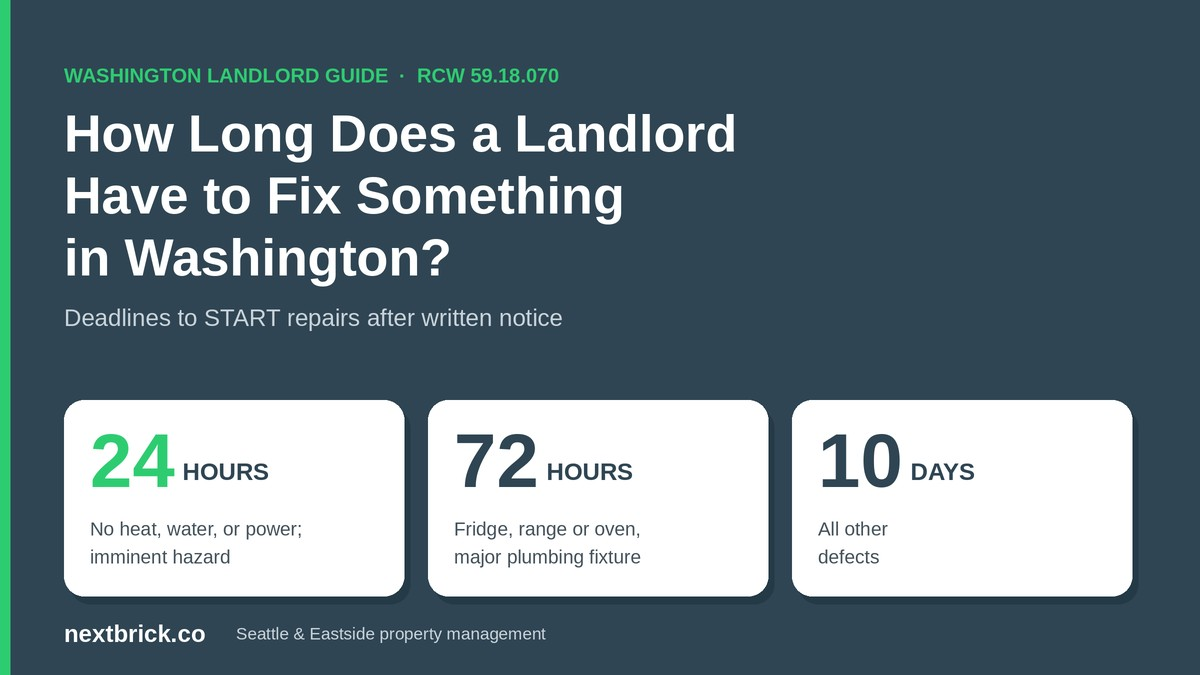
How long does a landlord have to fix something in Washington? After receiving the tenant's written notice, a landlord must start repairs within 24 hours for no heat, no hot or cold water, no electricity, or a condition imminently hazardous to life; within 72 hours for a broken refrigerator, range and oven, or major plumbing fixture the landlord supplied; and within 10 days for everything else.
These are deadlines to begin the work, not to finish it, and they apply statewide under RCW 59.18.070.
Find your situation below, then see what happens if the clock runs out.
The Washington Repair Deadline Chart
| Deadline to start repairs | What triggers it | Examples |
|---|---|---|
| 24 hours | No hot or cold water, heat, or electricity, or a condition imminently hazardous to life | Furnace out in winter, water heater failure, no power to the unit |
| 72 hours | No use of a landlord-supplied refrigerator, range and oven, or major plumbing fixture | Dead refrigerator, broken range or oven, a major plumbing fixture out of service |
| 10 days | All other defects | Leaky faucet, broken window latch, damaged cabinet |
These landlord repair time limits in Washington turn on three phrases. The landlord must commence remedial action, meaning begin it. The landlord must act "as soon as possible," so the deadline is an outer limit. And the burden is on the landlord "to see that remedial work under this section is completed promptly."
The deadlines apply "except where circumstances are beyond the landlord's control." If completion is delayed by such circumstances, including unavailable financing, the landlord must still remedy the condition as soon as possible. Our recommendation is to read that exception narrowly: get someone on site inside the deadline even when parts are delayed, and document why the finish took longer.
The clock starts with written notice.
Under RCW 59.18.070, it runs from when the landlord receives the tenant's written notice, delivered to the person designated to receive notices or to whoever collects the rent. The notice must identify the premises, the owner's name if known, and the nature of the problem. Tenants may report problems by phone or text at any hour, so treat any report as though the clock has started and confirm it in writing.
No Heat or Hot Water on a Friday Night: The 24-Hour Clock
Loss of heat, water, hot water, or anything imminently hazardous to life starts the shortest clock. Here is how a well-handled night looks:
| Time | What happens |
|---|---|
| Friday, 7:40 p.m. | Tenant emails a photo: no hot water, water heater leaking |
| Friday, 8:15 p.m. | Owner replies in writing and books a plumber |
| Saturday, 10:00 a.m. | Plumber on site, shuts off the leak, diagnoses a failed tank |
| Monday, 9:00 a.m. | Replacement tank delivered and installed |
A composite of a common call, not a specific property.
Work began about 14 hours after the report; the Monday finish came down to parts.
Getting inside on short notice is its own question. RCW 59.18.150 normally requires two days' written notice to enter, but allows entry without consent in an emergency. The statute doesn't define "emergency," so when you can, get the tenant's written okay for the visit time.
The Refrigerator Stops: The 72-Hour Clock
A landlord-supplied refrigerator, range and oven, or major plumbing fixture gets 72 hours. The two-day entry notice fits inside that window if you serve it the same day the repair notice arrives. The entry notice must give the date and time, or a window with the earliest and latest times, plus a phone number for objections or rescheduling. The tenant may not unreasonably refuse entry for necessary repairs.
A Leak That Can Wait: The 10-Day Clock
Everything else falls under 10 days. That includes most of what RCW 59.18.060 covers, the core of Washington state landlord repair laws. The statute requires landlords to keep the premises fit for human habitation and, among other duties, to:
- Substantially comply with applicable codes where a violation would endanger or impair the tenant's health or safety.
- Maintain roofs, floors, walls, chimneys, and foundations in reasonably good repair.
- Keep the unit reasonably weathertight.
- Keep electrical, plumbing, heating, and landlord-supplied appliances in reasonably good working order.
- Provide adequate heat, water, and hot water as reasonably required by the tenant.
- Provide reasonably adequate locks and keys.
Not every problem is the landlord's. There is no duty to repair a defect caused by the tenant, the tenant's family, guests, or others under the tenant's control. Tenants have duties too under RCW 59.18.130, such as keeping the unit clean and sanitary and replacing smoke detector batteries where required.
What Happens If the Deadline Passes?
Washington landlord-tenant law on repairs gives tenants five options. Before using any of them, the tenant must be current on rent, including utilities they agreed to pay, under RCW 59.18.080.
- Move out. Under RCW 59.18.090, the tenant may end the tenancy by written notice, owe no rent after leaving, and receive a pro rata refund of prepaid rent and a statement on the deposit.
- Repair and deduct, licensed work. Under RCW 59.18.100, after giving a good-faith estimate, the tenant may hire a licensed or registered contractor and deduct up to two months' rent per repair, and two months' rent total in any 12 months.
- Repair and deduct, the tenant's own work. Where no license is required, up to one month's rent per repair, and one month's rent total in any 12 months.
- Court or arbitration. Under RCW 59.18.110, rent can be reduced to reflect lost rental value; after a ruling, rent owed is limited to that reduced value until the defect is fixed.
- Rent escrow. Under RCW 59.18.115, rent goes into escrow after a local official certifies a condition that endangers health or safety. The inspection must happen within five days of the request.
For 10-day defects, repair and deduct in Washington state waits until 10 days after notice or two days after the landlord receives the estimate, whichever is later.
None of these is simply stopping rent. Every path runs through written notice, the repair-and-deduct limits, certified escrow, or a court.
Two further risks for owners.
Under RCW 59.18.240 and RCW 59.18.250, raising rent or ending a tenancy within 90 days of a tenant's good-faith complaint to a government authority or assertion of rights under the Residential Landlord-Tenant Act is presumed retaliatory unless the landlord shows otherwise.
And if a government agency condemns a unit or declares it unlawful to occupy because of code violations, RCW 59.18.085 can require relocation assistance of $2,000 or three times the monthly rent, whichever is greater, plus return of deposits and prepaid rent, subject to the statute's exceptions.
City Codes on Top of State Law
RCW 59.18.070 applies everywhere in Washington, but cities can add their own housing codes. Seattle is one example. Its Department of Construction and Inspections says, in Tip 604 (updated March 25, 2026), that rental heating must maintain daytime temperatures (7 a.m. to 10 p.m.) at no less than 68°F and nighttime temperatures at no less than 58°F from September through June. Seattle tenants can also request a city housing inspection. Wherever you own, check your city's housing code.
Five Habits That Keep Repairs Inside the Deadline
- One intake line that tenants can use at any hour.
- Sort on arrival into 24-hour, 72-hour, or 10-day.
- Two vendors per trade, licensed or registered, including one who takes after-hours calls.
- Timestamps for notice received, work started, and work finished.
- A follow-up to confirm the fix held.
Seasonal upkeep means fewer problems land on the 24-hour clock; our winter maintenance checklist and the real cost of deferred maintenance go deeper.
If you'd rather not be the one answering at 7:40 on a Friday night.
Next Brick's maintenance service offers support around the clock through licensed and bonded vendors. See pricing or reach our team.
Frequently Asked Questions
How long does a landlord have to fix something in Washington?
After written notice, a landlord must start repairs within 24 hours for no heat, water, or electricity or an imminent hazard, within 72 hours for key landlord-supplied appliances or a major plumbing fixture, and within 10 days for other defects.
Does the repair have to be finished within 24 hours?
No. RCW 59.18.070 requires the landlord to begin remedial action within the deadline and to see that the work is completed promptly.
Can a tenant withhold rent for repairs in Washington?
Not on their own. Tenants must be current on rent to use repair remedies, and rent can be reduced or escrowed only through the procedures in RCW 59.18.110 and RCW 59.18.115.
What is repair and deduct in Washington state?
If the landlord misses the deadline, RCW 59.18.100 lets a tenant hire a licensed contractor and deduct up to two months' rent per repair and per 12 months, or do the work themselves where no license is needed, up to one month's rent.
How long can a landlord wait to make repairs if parts are delayed?
The deadlines apply except where circumstances are beyond the landlord's control, and a delayed repair must still be finished as soon as possible. Our recommendation is to start within the deadline anyway and document the reason for any delay.
Can a landlord enter to make repairs without notice?
Only in an emergency. Otherwise, RCW 59.18.150 requires at least two days' written notice with the time of entry and a contact number.
This article is general information, not legal advice. Repair duties and remedies depend on specific facts and local codes. Confirm current requirements with your city's housing authority or a licensed Washington attorney.
