

Do things in order. A few Seattle rules only work if you handle them before the next step. Get the order right and the rest is straightforward.
Register with RRIO first. It’s $126 for a single-unit property, and it keeps your options open on rent later.
Write your screening criteria before you advertise — and put the required disclosures in writing before you take a screening fee.
Know the move-in caps. Deposit plus non-refundable fees can’t go above one month’s rent, and the deposit lives in a Washington trust account.
Do the move-in checklist properly. It’s what lets you make a claim on the deposit later.
Two numbers to remember: late fees are capped at $10 a month, and any rent increase needs 180 days’ notice.
Many people renting out a house in Seattle didn’t set out to become landlords. A job moved. A partner’s place made more sense. A parent’s house passed down. Now there’s a house you’d rather keep than sell, and a set of rules nobody handed you.
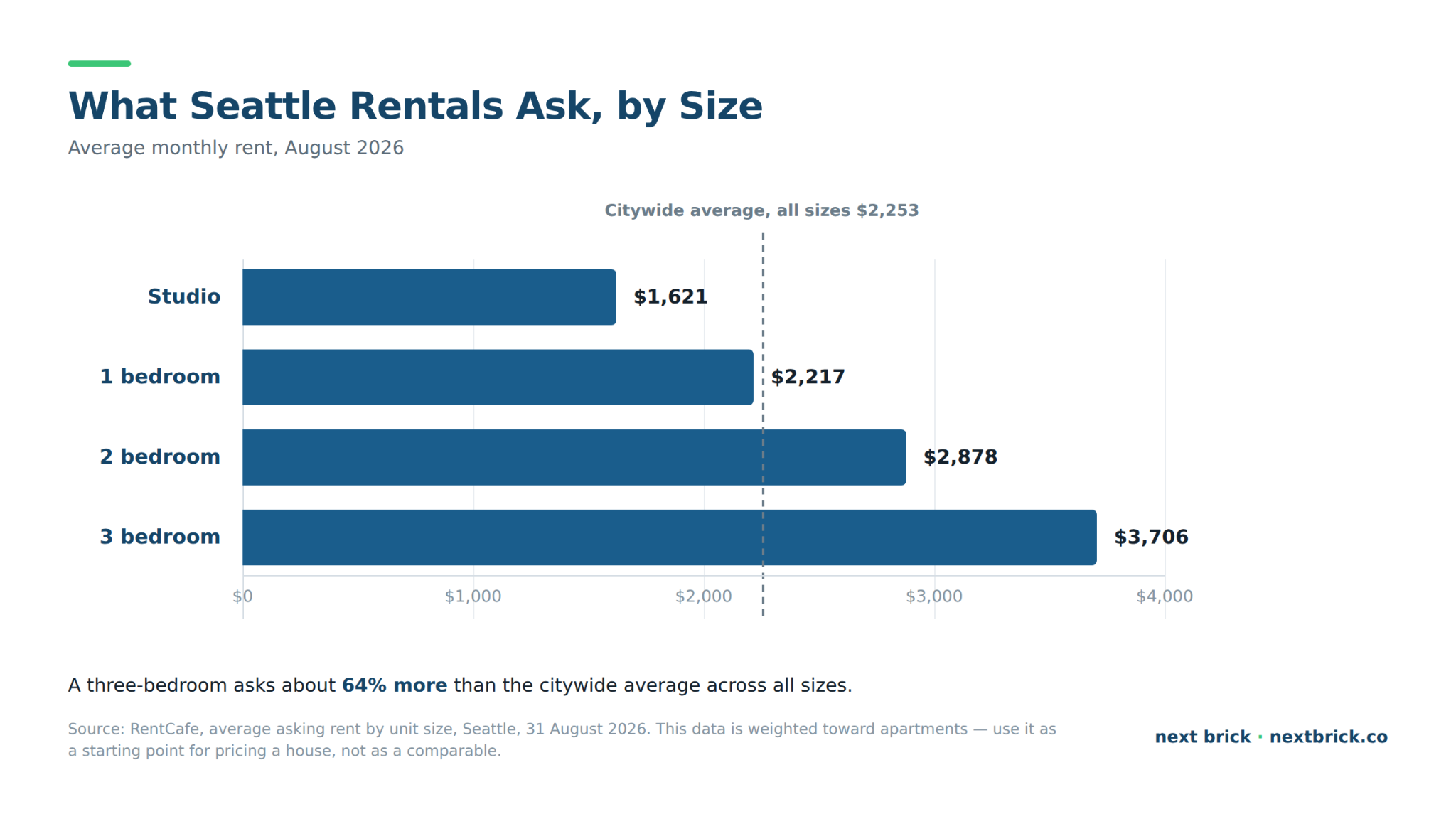
Here’s the encouraging part: houses rent well here. Three-bedroom rentals in Seattle averaged $3,706 a month as of August 31, 2026, against a citywide average of $2,253 across all unit sizes (RentCafe). Families who rent houses also tend to stay, which makes them some of the best tenants you can have.
The part people find harder is that Seattle has more rental rules than most cities, and a few of them depend on timing. Your screening criteria need to exist before applications arrive. The condition checklist needs to be signed at move-in, not later. RRIO registration matters years down the line when you want to raise the rent.
None of that is difficult. It just needs to happen in the right sequence — which is what the rest of this guide walks through. This is how to rent out your house in Seattle, step by step.
Six Seattle Rules Worth Knowing Up Front
A few of these come up sooner than you’d expect, so it’s worth a minute now.
| The rule | What it means for you |
|---|---|
| Late fees are capped at $10/month | Not a percentage of rent. Ten dollars a month (SDCI, Rental Agreement Regulation) |
| 180 days’ notice to change any housing cost | Six months. The state asks for 90; Seattle doubles it. Covers rent, parking, storage and utilities (SMC 22.206.180) |
| First-in-time | You have to offer to the first qualified applicant, so your written criteria do the choosing (SMC 14.08.050) |
| Deposits sit in a trust account | A Washington bank or escrow agent, and you tell the tenant in writing where it is (RCW 59.18.270) |
| The move-in checklist comes first | You need a signed condition checklist to hold a deposit (RCW 59.18.260) |
| You need a reason to end a tenancy | Even at the end of a fixed term, you offer renewal unless you have a listed just cause (SMC 22.205) |
All six are easy to handle when you know about them in advance. That’s the whole reason this guide is ordered the way it is.
PHASE 1 Before You List
Decide What You’re Signing Up For
Two decisions shape everything after them.
Long-term or short-term? In Seattle, a short-term rental means stays under 30 nights. You’d need an operator license at $75 per unit a year plus a business license tax certificate, and most operators can license only two units — their own home plus one more (Seattle Business Regulations). If you’ve moved out and kept the house, that cap usually makes the decision for you.
Self-manage or hire someone? This mostly comes down to where you live and how flexible your week is. Managing a Seattle house while you’re in Seattle is doable. Managing one from another time zone, with a six-month notice clock running in the background, is a bigger ask. We compared the two properly in how to choose a property management company.
Get the House Ready While It’s Empty
Seattle checks registered rentals against the RRIO Checklist. SDCI selects every registered property for inspection once during its first five years, and there’s a 10% chance it gets picked again in the five after that (SDCI).
The list is mostly practical stuff: working smoke and carbon monoxide alarms, safe electrical, no leaks or rot, secure handrails, heat that works, windows and doors that seal. Do all of it now, while the house is empty. It’s cheaper, it’s quicker, and nobody has to live around the work.
Two things that catch single-family owners specifically:
- Smoke and carbon monoxide alarms are a state requirement, not just an RRIO line item (RCW 43.44.110, RCW 19.27.530).
- Parking rent has to be separated from housing rent in the lease, via a separate parking agreement or addendum (SDCI). If your house has a garage or driveway you’re charging for, that’s a second document, not a line in the rent.
While you’re in there, think about what makes a house rent quickly. Fresh paint, appliances that work, and a bathroom that photographs well will do more for your return than a kitchen upgrade.
RRIO Registration: Seattle’s Rental Registration Rule
This is the step that’s easiest to miss and easiest to do.
| Item | Detail |
|---|---|
| Cost | $126 for a single-unit property — that covers the first unit, plus $31.50 for each extra one |
| Lasts | Two years, then you renew by the date on the certificate |
| When | As soon as you have a tenant. Short-term rentals that aren’t your main home register before listing |
| Inspection | Selected once in the first 5 years, then a 10% chance of a second in the next 5. You get at least 60 days’ notice. Pass, and you get a Certificate of Compliance |
| Inspection cost | $241.50 for a City inspector on a single-unit property, or a $63 filing fee if you use a qualified private inspector |
| If you’re late | A $52.50 late fee on overdue registrations and inspections |
| If you skip it | $150 a day for the first ten days, then $500 a day |
There’s a knock-on effect worth knowing: if SDCI has flagged your unit as not meeting the RRIO checklist, you can’t raise the housing cost until that’s sorted. And you can’t backdate the 180 days while you fix it. There’s a second route to the same result — a tenant who’s just received a housing cost increase notice can tell you in writing that the unit doesn’t meet the checklist, and the increase can’t take effect until the standards are fixed. Registering early and keeping the property in good shape closes off both.
One more thing to check rather than assume. Seattle only exempts a business from a license tax certificate if it earns $4,000 or less in the city and has no place of business here (Seattle City Finance). Whether one long-term rental clears that isn’t something we’ll guess at — it’s a two-minute call to City Finance on (206) 684-8484. Short-term rentals definitely need one.
Set the Rent
Pricing your first tenancy in Seattle matters more than it does elsewhere, because your opening number sticks around.
Two things limit changes later:
- No increase in the first 12 months of a tenancy, under Washington’s HB 1217 (RCW 59.18.700).
- After that, there’s a cap — 7% plus CPI, or 10%, whichever is lower. For calendar 2026 it’s 9.683%. Commerce sets the next year’s figure each July, and 2027 is already fixed at 10% (Commerce’s HB 1217 resource center).
Some homes are exempt under RCW 59.18.710 — newer builds where the first certificate of occupancy was issued within the last 12 years, an owner-occupied house where you rent out no more than two units or bedrooms, a duplex, triplex or fourplex where you live in one unit as your main home, or a setup where your tenant shares your kitchen or bathroom. Those owner-occupancy exemptions don’t apply if the owner is a REIT, a corporation, or an LLC with a corporate member. If you’ve moved out and you’re renting the whole house, you’re most likely not exempt.
Add the 180-day notice rule and the picture is clear: adjusting rent in Seattle takes six months to take effect. So the opening number is worth getting right. It’s why we treat rent-setting as its own piece of work, and the vacancy calculator is a quick way to see what asking too much costs you in empty weeks.
Want this as a one-page checklist?
Everything you need to rent out your house in Seattle, condensed to a printable page you can work through in order — registration, screening, move-in, and the dates to diary. Ask us for the checklist and we’ll email it over. No charge, no obligation.
Finding a Tenant
Write Your Screening Criteria Before You Advertise
Seattle’s first-in-time rule asks two things of you: tell applicants what your screening criteria are, and offer the tenancy to the first qualified applicant with a complete application (Seattle Office for Civil Rights).
Notice the order. Your criteria are what does the selecting, so they need to be written and published before anyone applies. Once applications start coming in, you work through them in order, and the first one that meets your bar gets the offer.
So decide it all up front: income multiple, credit threshold, rental history, pet policy. Write it down. Keep it objective.
Before you take a screening fee, put the disclosures in writing.
RCW 59.18.257 asks you to tell the applicant what you’ll look at, what would get them declined, the name and address of the screening company, and whether you accept a reusable screening report. If you decline someone, you owe them a written adverse action notice saying why.
And one that catches people out: under RCW 59.18.255, when an applicant has a housing voucher you subtract the voucher from the rent before you apply your income multiple. A 3x rule applied to the full rent, rather than the tenant’s share, is a source-of-income violation.
Two other things shape what you can ask:
- Source of income is protected. A housing voucher, benefits, or other lawful income counts the same as a paycheck.
- Criminal history has limits. In March 2023 the Ninth Circuit struck down the part of Seattle’s Fair Chance Housing rules that stopped landlords from asking, and the City no longer enforces that piece. You still can’t require someone to disclose it (with limited exceptions), turn someone down because of it, or advertise in a way that rules out people with records (Seattle Office for Civil Rights).
That second one is genuinely fiddly, and it’s worth getting advice before you put anything about criminal history into your criteria. It’s part of what we’ve built into resident screening.
List It, and Keep a Record
Good photographs, an honest listing, syndication to the sites renters actually use — that part works the same as anywhere. We handle it as its own process in property marketing.
What’s different here is the paperwork. Because you’re offering in order of arrival, note the date and time each completed application comes in, and jot down how each one measured against your published criteria. It takes seconds, and it means you can always show your working.
One requirement lands earlier than people expect: you give applicants the Renter’s Handbook when they apply, not when they sign.
Move-In
What You Can Collect
Seattle caps move-in money, and the caps are calculated from the first full month’s rent (SDCI).
| Charge | Limit |
|---|---|
| Deposit + non-refundable move-in fees, together | No more than one month’s rent |
| Non-refundable move-in fees on their own | No more than 10% of the first month’s rent, and only for screening or end-of-tenancy cleaning |
| Pet deposit | No more than 25% of the first month’s rent |
| Last month’s rent | Allowed, under RCW 59.18.253(2) |
Your tenant also gets to choose how to pay it. Seattle lets renters spread move-in costs over installments, with no extra fee and no interest:
| Tenancy | Installments |
|---|---|
| Six months or longer | 6 monthly payments |
| 30 days to six months | 4 monthly payments |
| Month-to-month | 2 monthly payments |
| Pet deposit | 3 monthly payments |
Worth planning around. If you were counting on the full deposit before you fly out, it might arrive over six months instead.
Then there’s where it sits. Under RCW 59.18.270, the deposit goes into a trust account at a Washington bank or licensed escrow agent. You give the tenant a receipt and tell them in writing where the account is. Any interest is yours unless the lease says otherwise. Keep it separate from your own account — it makes move-out much simpler.
The Move-In Checklist
Twenty minutes here saves a lot later.
RCW 59.18.260 says you can only collect a deposit if the rental agreement is in writing and you give the tenant a written checklist describing the condition of the property, including anything already damaged, at the start of the tenancy. You both sign and date it, and the tenant keeps a copy. Without it, the deposit has to go back.
Walk it room by room, take photos with the date on them, and write down what’s already worn. Being specific is the point — a vague checklist doesn’t help either of you when you’re comparing notes a year later.
What Else to Hand Over
The Renter’s Handbook comes up at four moments: when someone applies, when they sign, once a year for month-to-month tenants, and any time the City updates it. Put the annual one in your calendar — it’s the one people forget.
Washington also asks for a few standard disclosures under RCW 59.18.060: mold information approved by the Department of Health, and written fire safety information covering smoke detection, sprinklers, alarms, your smoking policy, and whether there’s an evacuation plan.
If the house was built before 1978, federal law asks for more than a form: the lead hazard pamphlet, a lead warning statement in the lease, any records or reports you hold, and a 10-day opportunity for the tenant to have the place inspected.
One more that rarely makes these guides: Washington gives survivors of domestic violence, sexual assault, stalking and harassment specific rights around ending a tenancy and changing locks (RCW 59.18.575 onward). Worth knowing before the situation arises rather than during it.
Living With It
What Runs in the Background
Rent increases. 180 days’ written notice for any change to housing cost — which in Seattle means rent plus things like parking, storage and utilities (SMC 22.206.180).
The notice also has to say which kind of increase it is — below the state maximum, or at it. And if you’re claiming one of the RCW 59.18.710 exemptions, RCW 59.18.720 asks you to state the facts behind it or attach the documents. Getting the 180 days right and the notice content wrong still leaves you exposed.
If the increase reaches 10% or more in a 12-month period, Economic Displacement Relocation Assistance kicks in and you attach the EDRA notice with it. Tenant households at or below 80% of Seattle’s area median income can claim three times their monthly housing cost from the City, and you reimburse the City (SDCI).
Late fees. $10 a month. Seattle also doesn’t allow charging a fee for sending a tenant a notice, or penalizing a month-to-month tenant who only stays a month.
Repairs and access. Answer repair requests within the statutory timeframes and give written notice before you come by. This is the part self-managing owners feel first — a broken heater doesn’t wait for Saturday. It’s why maintenance coordination exists as a service.
Fixed-term leases need a decision. Somewhere between 60 and 90 days before the term ends, you offer a reasonable renewal unless you have a just cause. Letting it quietly run out isn’t an option, so put a reminder in for it.
One for the 2027 Calendar
Seattle’s junk fee ordinance (CB 121254, passed in August 2026) takes effect July 1, 2027. It isn’t limited to new agreements. The Mayor’s Office FAQ puts the transition rule plainly:
“A landlord may continue to charge fees prohibited by this legislation until the end of an existing lease term or July 1, 2027, whichever is later.”
Read that twice if you rent month-to-month. A month-to-month tenancy has no lease term running past July 2027, so it’s caught on day one. (Seattle Mayor’s Office)
The banned list is also much wider than the headlines suggested. Going: fees for using in-unit appliances or features (portable cooling excepted), common-area access fees, fees to accept rent by check, money order, cashier’s check or ACH, mail and package fees, fees for doing things tenant-protection law already requires of you, partial change-of-tenancy fees, pet fees other than a pet damage deposit, and fees for landlord-provided insurance. The Mayor’s FAQ lists more besides — admin fees, lease-signing fees, repair-request fees, technology and “benefits package” fees, valet garbage, landscaping, even lease renewal and deposit-return fees.
If you’re writing your first lease now, the easy move is to leave all of it out from the start.
We’ve mapped the full timeline in the junk fee ordinance guide.
Ending a Tenancy
Seattle’s Just Cause Eviction Ordinance covers month-to-month tenants, verbal agreements, and fixed terms that are ending. You need one of the listed reasons. Two come up most for someone renting out a former home:
- You want to move back in. That’s allowed, with 90 days’ written notice, for you or an immediate family member making it their main home.
- You want to sell. Also allowed for a single-family home, with 90 days’ written notice before the sale.
Most just cause reasons don’t come with relocation assistance. Two tenant protections can shift the timing though: a low-to-moderate-income renter who’d have to move between December 1 and March 1 has a defense if you own four or more units (SMC 22.205.080), and a renter who’s a student or school employee has a school-year defense (SMC 22.205.110).
At the end, you have 30 days. Under RCW 59.18.280, that’s 30 days from the tenancy ending and the tenant moving out to either return the deposit or send a written statement of what you’re keeping and why.
This is where the move-in checklist pays off. Normal wear isn’t damage, and a dated record of how the house looked on day one is what makes that conversation easy.
What It Costs to Rent Out Your House in Seattle
Beyond the mortgage, here’s what to budget for. Treat these as planning figures rather than quotes.
| Item | Notes |
|---|---|
| RRIO registration | $126 per single-unit property, every two years; $52.50 late fee if you miss the date |
| RRIO inspection | $241.50 with a City inspector, or a $63 filing fee if you use a private one |
| Landlord insurance | Your homeowner’s policy usually won’t cover a tenanted house — you’ll want a landlord (dwelling) policy |
| Maintenance and repairs | A percentage of annual rent; older houses sit at the higher end |
| Vacancy | The one people underestimate. Each empty week is about 2% of your gross annual rent |
| Turnover | Cleaning, paint, marketing and screening between tenants |
| Property management | Usually a percentage of rent collected, plus a leasing fee when a new tenant signs |
| Taxes | Rental income is reportable, and expenses and depreciation may offset it — worth an hour with your accountant |
The two that decide whether this works are vacancy and turnover. A house that rents three weeks faster often beats a house that rents for $100 more.
Should You Self-Manage?
Plenty of Seattle owners do it well. It suits you if you live nearby, have some flexibility during the day, don’t mind admin, and you’re renting one house to one household.
It gets harder across time zones, or when the reminders stack up — the 180-day clock, the annual handbook, the RRIO renewal, the renewal window — or when a repair call comes in during a meeting you can’t leave.
There’s no right answer. The question is just whether there’s a system, and whether it depends on you being free.
Frequently Asked Questions
Do I need to register my rental with the City of Seattle?
Yes, with limited exceptions. It’s $126 for a single-unit property and lasts two years. There’s a $52.50 late fee on overdue registrations, and SDCI lists penalties of $150 a day for the first ten days and $500 a day after that if you don’t register at all.
How much deposit can I charge in Seattle?
Your deposit and any non-refundable move-in fees together can’t go above one month’s rent. The fees on their own cap at 10% of the first month’s rent, and a pet deposit caps at 25%. Tenants can also pay in installments — six monthly payments on a lease of six months or more.
Can I pick whichever tenant I like best?
Not quite. Seattle’s first-in-time rule means you publish your criteria and then offer to the first qualified applicant who submits a complete application. Your written criteria are what does the choosing, which is why they go up before you advertise.
How much notice before I raise the rent?
180 days in Seattle — six months, double the state requirement. The increase itself is capped at 7% plus CPI or 10%, whichever is lower: 9.683% for calendar 2026, and 10% for 2027, which Commerce has already published. The notice also has to say whether the increase is below the state maximum or at it. And you can’t raise rent in the first 12 months of a tenancy.
What if I skip the move-in checklist?
Then the deposit goes back. Washington law only lets you hold a deposit if you gave the tenant a written condition checklist at the start of the tenancy and you both signed it.
Do I have to give an applicant anything before charging a screening fee?
Yes. RCW 59.18.257 asks you to say in writing what you’ll look at, what would get someone declined, the screening company’s name and address, and whether you accept a reusable screening report. Decline someone and you owe them a written adverse action notice.
Can I ask about criminal history in Seattle?
You can ask — a 2023 Ninth Circuit ruling ended the ban on asking, and the City no longer enforces it. You still can’t require disclosure (with limited exceptions), decline someone because of it, or advertise in a way that excludes people with records. Worth getting advice before you write it into your criteria.
Can I move back into my own house?
Yes, with 90 days’ written notice, for you or an immediate family member making it their main home. Selling a single-family home also takes 90 days’ notice. Winter and school-year protections can affect the timing.
Does the 2027 junk fee ban apply to my existing tenant?
Eventually, and sooner than most people expect. You can keep charging a banned fee until your existing lease term ends or July 1, 2027, whichever is later. A month-to-month tenancy has no term running past that date, so it converts on July 1, 2027.
What’s the first step to rent out your house in Seattle?
Register with RRIO and get the house through the RRIO Checklist while it’s empty. Then write your screening criteria and disclosures, before you advertise. Those two set up everything else.
Would short-term renting be better?
Usually not, if you’ve moved out. Short-term means stays under 30 nights, needs a $75 per-unit operator license plus a business license tax certificate, and most operators can only license two units — their own home plus one more.
Where to Start
The short answer to how to rent out your house in Seattle: register with RRIO, get the house sorted while it’s empty, and write your criteria before you photograph a single room. Everything else follows from those three.
And if the calendar side is what’s putting you off — the 180-day clocks, the annual handbook, the renewal windows — that’s the part we do every day. Talk to our Seattle property management team or get in touch.
We manage across Seattle, Bellevue, Redmond, Mercer Island and Lynnwood for 6% of rent collected ($150 a month minimum), with a separate leasing fee and a $250 renewal fee — and no maintenance markups and no inspection fees, which is where most owners actually get nickel-and-dimed. See the full pricing, and the four owner guarantees.
