
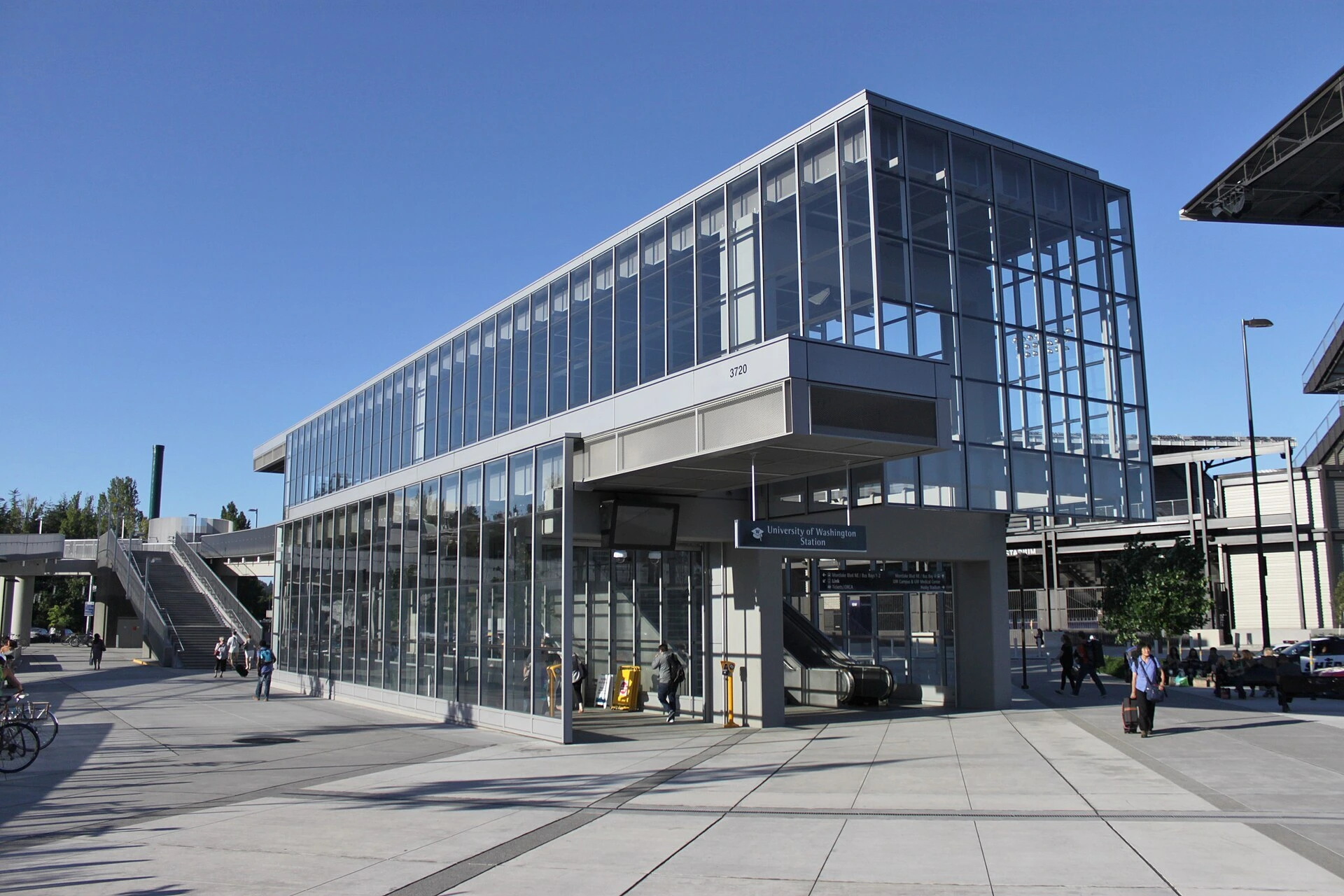
If you own a rental in Capitol Hill, the U District, downtown, Northgate, or the Central District, something quietly useful happened to it on March 28, 2026.
Your tenant can now get to Bellevue and Redmond without a transfer.
That’s it. No new track through those neighborhoods, no construction, nothing you had to do. Sound Transit connected the 2 Line across I-90, and every Seattle station on the corridor became a one-seat ride to the Eastside. A software engineer at a Redmond campus, a nurse at a Bellevue hospital, a couple with one job on each side of the lake — all of them can now live in your building and skip the car.
For most of the last decade, a Seattle landlord competed for Seattle workers. As of this spring, you’re competing for Eastside workers too, without giving up a single Seattle tenant.
Here’s what that’s worth, neighborhood by neighborhood, and how to actually collect it — because in Seattle property management, the collecting is the hard part, not the opportunity.
What Seattle Rentals Are Renting For Along the 2 Line
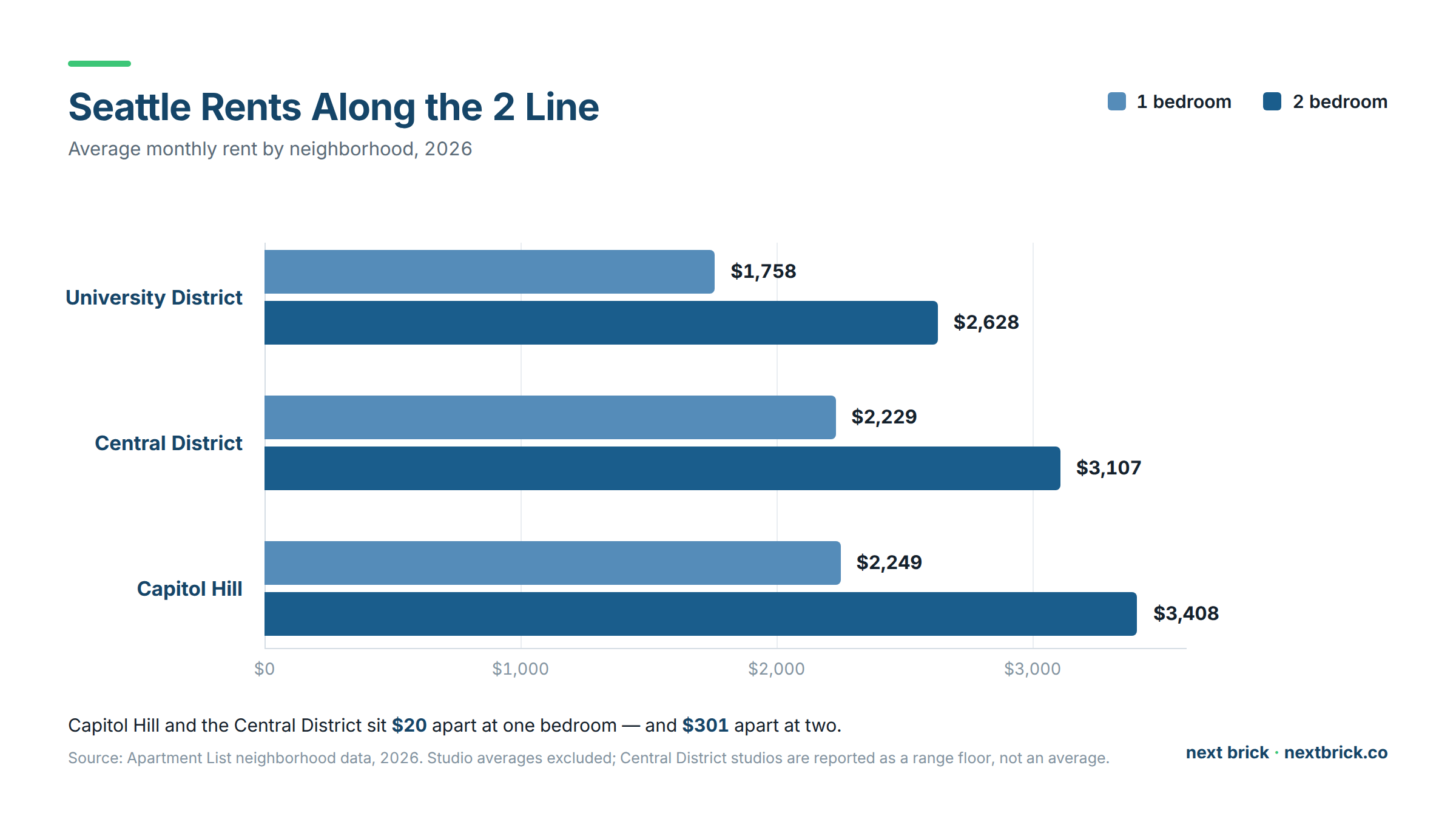
Start with where the market is. These are current neighborhood averages for three of the corridor’s biggest rental submarkets.
| Neighborhood | Studio | 1 bedroom | 2 bedroom |
|---|---|---|---|
| University District | $1,247 | $1,758 | $2,628 |
| Central District | from $1,165 | $2,229 | $3,107 |
| Capitol Hill | $1,687 | $2,249 | $3,408 |
Source: Apartment List neighborhood data, 2026. Seattle citywide averages roughly $2,200 across all property types, up about $48 year over year — a market rated warm, running about 5% above the national average.
Three things in that table are worth real money.
A two-bedroom swings $780 across one train line. Same city, same rail, same commute to Bellevue — $2,628 in the U District, $3,408 on Capitol Hill. Neighborhood, not transit, is still doing most of the pricing work. If you own in a lower-priced pocket, the 2 Line doesn’t move you to Capitol Hill numbers, and any advice suggesting it will is selling you something.
The Central District already prices like Capitol Hill at one bedroom. $2,229 versus $2,249 — a $20 difference. But at two bedrooms the gap opens to roughly $300. That’s the most interesting number on this page, because there’s no obvious reason a Central District two-bedroom should trail Capitol Hill by 9% when the one-bedrooms are level. That gap is where the upside sits.
The U District is the value play on the line. A U District two-bedroom at $2,628 now reaches Redmond Technology without a transfer, at $780 less than Capitol Hill. For a tech worker who doesn’t want to pay Eastside prices, that’s a genuinely compelling pitch — and most U District listings are still written entirely around the university.
The Central District Got Something Nobody Else Did
Every neighborhood above gained a destination. One gained a station.
Judkins Park opened on March 28, 2026, in the I-90 median between Rainier Avenue S and 23rd Avenue S, with entrances on both streets. It’s the only new Seattle station the 2 Line adds — and the first time the Central District has had light rail at all.
This is an in-city infill station. People walk, bike, or bus to it; they don’t drive and park the way they do at Lynnwood City Center. So the benefit is concentrated: a unit a few minutes’ walk from an entrance is a genuinely different product than it was in February, while one a mile away is much the same as it always was.
Remember that $300 two-bedroom gap against Capitol Hill. A Central District two-bedroom within a short walk of Judkins Park now has a commute story Capitol Hill can’t match — direct to Bellevue and direct to downtown — while still priced below it. Closing even half that gap on a single unit is about $150 a month, or $1,800 a year, for work that amounts to repricing and rewriting a listing.
Worth walking the route yourself before you write "steps from light rail." The two entrances behave differently — 23rd Ave opens onto a walkable arterial and the park on the I-90 lid; the Rainier Ave side faces a much busier road.
Station access and connecting bus service change over time. Check Sound Transit and King County Metro for current details.
Six Seattle Property Management Rules That Decide How Fast You Collect It
Legal disclaimer
These summarises Washington State and City of Seattle rental regulations as they stood in August 2026, in general terms and plain language. It is not legal advice and is not a substitute for reading the ordinances or speaking to a qualified professional. Seattle’s rental rules change frequently, several figures below are recalculated annually, and how any rule applies depends on facts specific to your property, your tenancy, and your tenants.
Verify current requirements with the Washington State Department of Commerce, Seattle SDCI, and the Seattle Office for Civil Rights, and consult a Washington licensed manager or a landlord-tenant attorney before serving notice, setting screening criteria, or changing any housing cost.
The Eastside demand is already here. These six rules decide how quickly it reaches your bank account — and one of them is the reason a Seattle owner’s timeline looks nothing like a Bellevue owner’s.
The 180-day notice — this is the one that matters most. Seattle requires six months’ written notice before you raise any housing cost. Washington State requires 90 days; Seattle doubles it. A Bellevue owner who served notice in April was collecting by July. A Seattle owner who served the same day waits until October. Same train, same demand, three extra months.
The rent cap (HB 1217) — 9.683%. Washington’s ceiling on how much of that new demand you can capture in a single year on a sitting tenant. The formula is 7% plus CPI or 10%, whichever is lower, so a new figure publishes each January. It’s statewide, so your competitors across the lake face the same limit. No increase at all during the first 12 months of a tenancy. Manufactured and mobile homes have a separate, lower cap, and some properties are exempt — including new construction within 12 years of its certificate of occupancy, owner-occupied triplexes and fourplexes, and certain affordable housing.
Housing cost, not just rent. Relevant the moment you reconsider the parking stall — and a tenant who now rides to Redmond may not want it. Seattle counts parking, storage, and utilities in the same number as rent, so changing one is changing the total.
EDRA — the 10% line. Follows directly from the point above. Economic Displacement Relocation Assistance triggers when total housing costs rise 10% or more in twelve months, and eligible tenants can receive three times the monthly housing cost from the City, which you reimburse. With the cap at 9.683%, a maximum rent increase plus a modest parking bump crosses it.
RRIO registration. Your Eastside pitch is worth nothing until this is current — a lapsed Rental Registration and Inspection Ordinance registration blocks any housing cost increase outright, and you can’t backdate the six months while you sort it out.
First-in-time. A better commute should mean more applications. In Seattle that doesn’t mean more choice: you must publish your screening criteria and rent to the first qualified applicant, not the best one. So the extra demand the 2 Line brings converts into a better tenant only if your criteria were written before the listing went live.
None of these stop you from benefiting from the 2 Line. They set the order and the calendar — which is why the next section is about what you can start today, not in February.
How to Turn the 2 Line Into Higher Rent
The good news about a six-month notice rule is that the clock only matters for sitting tenants. Several of the best moves cost nothing and start today.
Rewrite the listing around the Eastside. This is the free one, and almost nobody has done it. "One-seat ride to Bellevue and Redmond" is new information to most renters, and it reaches a tenant pool that wasn’t looking at your neighborhood in 2024. Our property marketing work starts here because it’s the highest return per hour available.
Reprice at turnover. A vacancy is the one moment no notice period applies. If a unit turns over this autumn, that’s your repricing event — and it needs to be right first time, because correcting it later takes six months. That’s the rent-setting discipline that decides most of your annual return.
Write screening criteria before you list. Under first-in-time you can’t hold out for a better applicant, so the criteria are the decision. Getting them right in advance is what resident screening actually means in Seattle.
Compete on speed, not just price. Faster leasing is the benefit the ordinances don’t delay. Three weeks of avoided vacancy on a $3,107 two-bedroom is roughly $2,175 — often more than a rent increase would have produced in the same period. The vacancy calculator runs it for your unit.
Serve rent increase notices on a calendar, not a whim. Decide the number in August, model rent and ancillary charges together against both 9.683% and 10%, verify RRIO is current, then serve. February arrives on schedule.
Reconsider the parking stall. A tenant riding to Redmond may not want it. Storage, a workspace, or bike parking can be worth more — and unlike rent, you can change that on a new tenancy immediately.

Frequently Asked Questions
How does the 2 Line help Seattle landlords?
It connects Seattle stations directly to Bellevue and Redmond without a transfer, which widens the tenant pool for rentals in Capitol Hill, the University District, downtown, Northgate, and the Central District to include Eastside workers.
Which Seattle stations does the 2 Line serve?
The 2 Line diverges from the 1 Line at International District/Chinatown. Within Seattle it serves the downtown and north Seattle stations shared with the 1 Line, plus Judkins Park in the Central District. It does not serve stations south of International District/Chinatown.
How much notice do I have to give before raising rent in Seattle?
Seattle requires 180 days’ written notice for any increase in housing costs, including rent, parking, storage, and utilities. Washington State requires 90 days, so Seattle’s requirement is double the statewide minimum.
How much can I raise rent in Seattle in 2026?
Washington’s HB 1217 caps increases at 9.683% for calendar year 2026. Seattle’s EDRA ordinance is separately triggered at 10% of total housing costs in twelve months, so the practical ceiling sits just under the state cap.
What do Seattle rentals go for by neighborhood?
Two-bedrooms currently average about $2,628 in the University District, $3,107 in the Central District, and $3,408 on Capitol Hill. Citywide the average across all property types is roughly $2,200.
How much does a Seattle property manager cost?
Full-service Seattle property management typically runs 8–10% of collected rent plus a leasing fee. Next Brick charges a flat 6% with a leasing fee of 50% of one month’s rent —
Talk to a Seattle property manager
Talk to our Seattle property management team or get in touch and we’ll tell you what your unit should rent for now that the Eastside is one train away — backed by our owner guarantees.
206.395.6799 · nextbrick.co
