

This article was written from the ordinance text published on Seattle Legistar, days after passage — not from a final enacted ordinance with SDCI's rules attached. It is general information, not legal advice, and it creates no attorney–client relationship.
The details most likely to change are the ones owners want to act on: the dollar caps, pet deposits, and how the rules apply to tenancies already in place. Verify against the enacted ordinance and talk to a Washington landlord-tenant attorney before you serve notice, amend a lease, or reprice a unit.
Seattle banned a long list of rental fees on August 11, 2026. Council vote: 8–0.
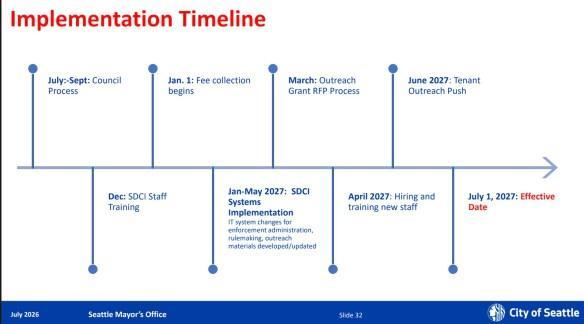
It starts July 1, 2027 — but only for agreements and renewals signed after that date. Sitting tenants keep their current terms until they renew.
Seattle needs 180 days' notice to change any housing cost. So your real deadline is six months before each tenancy's first renewal. The earliest land around January 2, 2027.
Recurring pet rent goes. So do package fees, payment-method fees, and fees for using in-unit appliances like a washer-dryer or AC unit.
Being off the banned list isn't enough. Seattle is switching to an allow-list: a fee is legal only if a law specifically permits it.
On Tuesday, August 11, 2026, Seattle City Council voted 8–0 to ban a long list of rental fees. The Seattle junk fee ordinance — reported as CB 121254 — takes effect July 1, 2027.
Now read the line most coverage skipped. The rules apply to "any rental agreement or renewal of a rental agreement entered into after July 1, 2027." Existing tenancies keep running on their current terms until they renew.
That one sentence changes everything. There is no single portfolio-wide deadline. Your deadline is 180 days before each tenancy's first renewal on or after July 1, 2027 — because Seattle requires six months' notice to change any housing cost. For units renewing that first week, notice is due around January 2, 2027. For a tenancy renewing in November 2027, it's May. For a month-to-month roll, nobody yet knows.
So the job isn't marking one date on a calendar. It's mapping a renewal calendar and working backward from every row.
What the Seattle Junk Fee Ordinance Bans
Mayor Katie B. Wilson introduced the bill; Councilmember Dionne Foster sponsored it in Council. Three amendments that would have softened it — including a pet rent carve-out — failed. Two that strengthened enforcement passed 8–0, which is why SDCI's powers ended up as broad as they are.
Under SMC 7.24.040.C, these charges are prohibited:
| Prohibited charge | Note |
|---|---|
| Any fee for keeping a pet | "Whether the fee is imposed once or periodically and regardless of how the fee is named or described." Only exception: a pet damage deposit under SMC 7.24.038. |
| Package and mail collection fees | Includes fees to receive or collect mail. |
| Payment-method fees | Check, money order, cashier's check, or ACH. |
| Fees for using an in-unit appliance or feature | Exception for portable cooling device rentals under separate law. |
| Common area access fees | Exception for temporary exclusive use, e.g. renting a clubhouse. |
| Fees for doing a landlord's job | Duties already required under SMC 22.206.160. |
| Fees for adding or removing a tenant | A partial change of tenancy. |
| Landlord-provided insurance charges | Prohibited unless specific conditions are met. |
The in-unit appliance line is the one owners miss. If you charge separately for a washer-dryer or an AC unit, that revenue is going — and it shows up in almost no coverage of this ordinance.
Pet fees: what's true today vs. what changes
Worth separating, because this is the first question everybody asks.
Today, per Seattle SDCI: you may charge pet rent. Non-refundable pet fees are already banned. A refundable pet damage deposit is capped at 25% of the first full month's rent, one per household no matter how many animals.
What's new: the ban on recurring pet rent. One-time non-refundable pet fees were already out. The "once or periodically… regardless of how named" wording just closes the door on renaming pet rent as a one-off charge.
The banned list isn't the point. The rule behind it is.
Owners keep asking "is my fee on the list?" That's the wrong question, because SMC 7.24.040.A flips the default:
"Mandatory or optional fees other than those identified in this Chapter 7.24 or Chapter 7.25, or chapter 59.18 RCW, regardless of the name or description of the fee, constitute unfair or excessive fees, which are prohibited."
Seattle is becoming an allow-list city. A fee isn't legal because it dodged the banned list. It's legal only if Seattle's code or the state Residential Landlord-Tenant Act specifically authorizes it. "Regardless of the name or description" closes the renaming route.
That's why "administrative service fees" appear in every news report but nowhere in the text as a named category. They don't need to be named — an admin fee no statute authorizes is already prohibited by the framework.
There's a second trap in the same subsection:
"Fees not disclosed pursuant to the requirements of Section 7.24.039 constitute unfair or excessive fees, which are prohibited."
A perfectly legal fee becomes illegal if you don't disclose it right. Your screening fee, your late fee, your utility charge — all permitted, all prohibited the moment they're missing from the disclosure.
Sourcing note: every quoted passage above, plus the ban list, optional-service conditions and penalty schedule, comes from the ordinance document on Seattle Legistar. Vote and sponsorship details come from the Mayor's Office announcement. CB 121254 is the reported bill number, not yet verified against a signed ordinance.
What the Seattle Junk Fee Ordinance Costs You
In Seattle council testimony, one resident described paying almost $100 a month across pet rent, amenity fees, and common-area charges. (The Urban Institute's Denver analysis put fees like these at 10–30% of a renter's monthly cost, but from a sample of three providers — directional only.)
Take that $100 and put it against real Seattle rents:
| Unit | Monthly rent | $100/month as a share of rent |
|---|---|---|
| University District 1 bed | $1,758 | 5.7% |
| Seattle average, all types | $2,200 | 4.6% |
| Central District 1 bed | $2,229 | 4.5% |
| Capitol Hill 2 bed | $3,408 | 2.9% |
That's $1,200 per unit per year — $60,000 across fifty units.
The cheaper the unit, the bigger the hole. A U District one-bedroom loses nearly 6% of its rent; a Capitol Hill two-bedroom loses under 3%. If your portfolio skews toward smaller, lower-priced units — exactly where pet rent and amenity fees are most common — this lands harder than the citywide average suggests.
Figuring out what this costs your portfolio starts with a fee audit. We've put ours in a one-page checklist — ask and we'll send it.
What Happens If You Get It Wrong
Most coverage of the Seattle junk fee ordinance mentioned the City Attorney recovering three times the illegal fees. That's the smallest part of the exposure.
Start with the sentence that matters most to a portfolio owner: investigations can run building-wide or company-wide, not just per complaint. One tenant's grievance can become an audit of every unit you operate.
| Route | Exposure |
|---|---|
| SDCI citation, first violation | $750 |
| Subsequent violation within five years | $1,500 |
| Retaliation | $5,000 |
| Obstructing the Director | $5,000 |
| Private tenant action (SMC 7.24.060.A) | Actual damages, 12% annual interest, double the prohibited fee, double the civil penalty, plus attorney fees and costs. |
| Prohibited lease provisions | Up to $4,000 plus attorney fees. |
| Administrative remedy for a prohibited fee | Reimbursement plus interest, plus an extra amount equal to twice the fee. |
From January 1, 2028, these penalty amounts adjust annually with the housing component of the Consumer Price Index — so they rise every year after that.
The fee-shifting is what turns a small charge into a serious number. A $40 monthly pet rent, doubled, plus interest, plus a doubled civil penalty, plus the tenant's legal costs, is not a $40 problem.
One discrepancy we'd rather name than hide: the Mayor's Office describes the City Attorney recovering three times the illegal fees, while the tenant-remedy section of the text reads as double. These may be separate remedies through separate routes. We haven't been able to reconcile them.
The 10-day escape hatch nobody mentions
Buried in SMC 7.24.190.A.2 is the most useful paragraph in the ordinance for an owner who slips up. The Director can waive civil penalties if you make the tenant whole fast:
| If you pay the tenant the full remedy | Penalty waiver |
|---|---|
| Within 10 days of service of the Order | Up to 75% waived |
| Within 15 days | Up to 50% waived |
| After 15 days | None |
Two catches: the waiver is discretionary, not automatic, and it only covers penalties owed to the Department — not what you owe the tenant, and not a private lawsuit.
If a violation notice lands, the clock that matters is ten days long. That means someone has to open the mail, read it properly, and be able to authorize a refund inside a week. That's a management function, not a legal one.
Lose the records, lose the argument
Under SMC 7.24.045.A you must keep compliance records for three years: ads, listings, applications, leases and renewals, fee disclosures, variable-fee statements, rent and fee records, and vendor receipts.
Miss that, and the ordinance does something unusual:
"If a landlord fails to retain adequate records required under subsection 7.24.045.A, there shall be a presumption, rebuttable by clear and convincing evidence, that the landlord violated this Chapter 7.24."
In plain terms: no records means you're presumed guilty, and you have to disprove it — at a much higher standard than normal. If you run leasing through email threads, a spreadsheet, and two vendor portals, this is the line that should start a systems conversation. Three years of ads and fee statements is not something you reconstruct afterward.
Why "Just Add It to the Rent" Is Harder Than It Sounds
The obvious move is to fold lost fee revenue into base rent. In most cities that's a five-minute decision. In Seattle, three rules stack up against you:
- 180 days' notice. Any change to housing cost — rent, parking, storage, utilities — needs six months' written notice under SMC 22.206.180. Washington State requires 90. Seattle doubles it.
- The state caps the increase. HB 1217 limits annual increases to 7% plus CPI, or 10%, whichever is lower. For 2026 that's 9.683%, and a new figure publishes each January. Recovering $100 on a $2,229 unit eats about 4.5 points of a ceiling under ten.
- EDRA triggers at 10%. Economic Displacement Relocation Assistance kicks in when total housing costs rise 10% or more in twelve months. Eligible tenants can receive three times monthly housing cost from the City — which you reimburse.
You can't recover the fee revenue in one move. Half your headroom is gone before you've priced in market rent growth.
The percentages above are illustrative arithmetic on published figures, not a calculation of what any specific unit may lawfully charge. Rent cap and EDRA outcomes depend on the individual tenancy, increases already served in the prior twelve months, and exemptions that may apply to your building. Model your own numbers with counsel.
Map the Rolling Deadline Before You Miss It
Because the Seattle junk fee ordinance bites on each agreement or renewal after July 1, 2027, and because Seattle needs 180 days' notice, every tenancy has its own deadline.
This timeline assumes a tenancy renewing on or about July 1, 2027. Your actual notice deadline depends on when each tenancy renews — and whether a rolling month-to-month tenancy counts as a "renewal" has not been settled. Treat this as a planning framework, not a compliance calendar, and have counsel confirm the applicability rule against your lease documents before relying on any portfolio-wide date.
| Date | What has to be true |
|---|---|
| Now – November 2026 | Map every tenancy's renewal date. Audit every recurring charge: which are banned, which survive, what each earns. |
| November – December 2026 | Decide the restructure for the earliest-renewing group. Model it against the 2027 cap and the 10% EDRA line. |
| By January 2, 2027 | Serve 180-day notice on tenancies renewing early July 2027. Confirm RRIO registration first — a lapse blocks the increase outright. |
| January 2027 | Washington publishes the new annual cap. Re-run the model; 9.683% does not carry over. |
| Rolling through 2027 | For each later renewal, serve notice 180 days ahead. A November 2027 renewal means a May 2027 notice. |
| By July 1, 2027 | Ads, listings, applications and leases all carry the full disclosure. Banned fees gone from every template. |
A fifty-unit book with staggered renewals has fifty deadlines, not one — and the earliest is about twenty weeks away.
If that six-month rhythm sounds familiar, it's the same constraint we wrote about in what the 2 Line means for Seattle owners. Seattle is a city where every pricing decision gets made half a year early.
Two Questions Nobody Has Answered
Be suspicious of anyone who answers either of these confidently.
Does a month-to-month rollover count as a "renewal"? Most Seattle tenancies roll month-to-month after the initial term. If each rollover is a renewal, your entire sitting-tenant book converts almost at once. If it isn't, conversion happens gradually as fixed terms end. That single question decides whether this is a July 2027 problem or an eighteen-month one. First thing to put to counsel.
Is a revenue-neutral swap an "increase"? Remove $50 of pet rent, add $50 to base rent the same day, and the tenant pays the same total. Is that an increase for the state cap and EDRA? Read it as total housing cost and arguably no. Read it as rent and arguably yes. Untested — and the answer changes what a compliant restructure looks like.
Your Checklist Between Now and Christmas
- Map renewals before you touch pricing. You can't serve notice on a schedule you haven't built. Most owners skip this step.
- Run a fee audit. Under the Seattle junk fee ordinance's allow-list logic this isn't optional housekeeping. Every recurring charge, what it earns, whether it survives. Most owners find a charge they'd forgotten they levy — in-unit appliance fees are the ones catching people out.
- Separate the deposit from the rent. The pet damage deposit — capped at 25% of the first full month's rent, one per household — is the pet charge that survives. Renaming pet rent as a one-off would not work.
- Rewrite disclosure and advertising templates now. Cheap to change in October, expensive in June. This is standard work in our property marketing process.
- Audit your payment portal, not just your lease. Payment surcharges live in software. That's a vendor conversation with a lead time.
- Check RRIO before December. A lapsed registration blocks any housing cost increase, and you can't backdate the 180 days while you fix it.
- Update screening criteria. If pet economics move to deposits, your pet policy and resident screening criteria need to say so — under first-in-time, published criteria are your only selection tool.
- Reprice new tenancies immediately. The notice rule governs sitting tenants. Anything you lease between now and July 2027 can be priced on the new economics from day one. Faster leasing offsets some of the lost fee income; the vacancy calculator shows how much.
The Rest of the Fee Picture
A checklist, not law.
These reflect the ordinance text published on Legistar. Amendments, the enacted ordinance, and SDCI's implementing rules — the Director can add further fees to the prohibited list — can all move these details before July 1, 2027.
Disclosure is bigger than "put it in the ad." The Seattle junk fee ordinance rewrites it entirely. Under SMC 7.24.039, disclosure must appear in ads, listings, applications, and conspicuously before the first page of the lease, on a form no longer than two pages. It must state monthly rent, any discount and its duration, which utilities the tenant pays, the amounts of all mandatory and optional fees including variable ones, and the total monthly cost. Variable fees need a 12-month average plus monthly statements. The form updates every 12 months or whenever a fixed fee changes. You may not charge for preparing or delivering it. SDCI will publish a model form.
Still allowed: late rent fees, security deposits, non-refundable move-in fees, tenant screening fees, pet damage deposits, utility pass-throughs, and reimbursement for tenant-caused damage — all under their existing limits.
The utility line needs care.
A straight pass-through of metered cost survives. Utility administration charges and common-area maintenance fees are treated differently, and the ordinance separately bans common area access fees. If you add a margin or admin charge on top of a utility bill, treat it as at risk and verify before July 2027.
Now capped at a hard number — small charges sitting in templates written years ago:
| Charge | Cap |
|---|---|
| Replacement key | Lesser of actual cost or $50. |
| Tenant-caused lockout | $50 during specified weekday hours, $150 outside them — nothing if you're already at the property. |
| Returned payment | Lesser of your actual bank cost or $31. |
Optional services must meet five conditions, not three: clearly disclosed as optional; the tenant opts in in writing; you give written notice of how to opt out; they can opt out anytime without penalty; and the fee may not exceed your actual cost.
Read that last one again. You cannot make a margin on an optional service. Reselling a third-party amenity at a markup fails — and an opt-out-by-default service fails condition two before you even get to pricing.
What to take from this section.
The headline bans cost you revenue; this half costs you time. Payment surcharges live in your software. Key and lockout fees live in a template. Optional services live in a vendor contract. Disclosure lives in your listing feed. Four fixes, four different lead times — and none of them is a pricing decision.
Frequently Asked Questions
When does Seattle's junk fee ordinance take effect?
July 1, 2027 — but only for rental agreements and renewals entered into after that date. Existing tenancies continue on current terms until they renew. Council passed it 8–0 on August 11, 2026.
Which fees does the Seattle junk fee ordinance ban?
Any fee for keeping a pet — one-time or recurring, whatever it's called — other than a pet damage deposit. Also package and mail collection fees, payment-method fees for check, money order, cashier's check or ACH, fees for using an in-unit appliance or feature, common area access fees, fees for performing a landlord duty, fees for adding or removing a tenant, and landlord-provided insurance charges that don't meet the conditions.
Is pet rent banned in Seattle right now? Can I still charge a pet deposit?
Pet rent is currently allowed. If the drafted language holds, recurring pet rent would no longer be permitted for agreements and renewals subject to the new law after July 1, 2027. The refundable pet damage deposit under SMC 7.24.038 survives — capped at 25% of the first full month's rent, one per household regardless of how many animals. You could not replace pet rent with a one-time fee; non-refundable pet fees are already prohibited today.
Can I charge for a washer-dryer or in-unit AC?
No. Fees for using an in-unit appliance or feature are prohibited, with an exception for portable cooling device rentals under separate law.
What are the penalties for charging a banned fee?
SDCI citations run $750 for a first violation and $1,500 for a subsequent one within five years, plus $5,000 each for retaliation and obstruction. A tenant can sue for actual damages, 12% annual interest, double the prohibited fee, double the civil penalty, and attorney fees. Investigations can run building-wide or company-wide. The Director may waive up to 75% of civil penalties if you pay the tenant in full within ten days of the Order.
Is my fee legal if it isn't on the banned list?
Not necessarily. SMC 7.24.040.A says fees other than those identified in Chapter 7.24, Chapter 7.25 or chapter 59.18 RCW are unfair or excessive and prohibited, regardless of what the fee is called. A fee has to be affirmatively authorized, not just absent from the banned list. And a permitted fee that isn't properly disclosed is also prohibited.
Why is January 2027 a deadline if the law starts in July?
Because Seattle requires 180 days' written notice before any housing cost changes. For a tenancy renewing in early July 2027, notice is due around January 2, 2027. Later renewals have later deadlines — it's a rolling schedule, not one date.
Where This Leaves You
A unanimous council vote, a City Attorney who has said she'll enforce, company-wide investigation powers, and fee-shifting private actions. The Seattle junk fee ordinance is not a rule to plan on testing.
The revenue is going. What's left to decide is whether you map your renewals this fall and restructure deliberately — or find out next summer that the six-month clock ran out on your earliest group back in January.
If you'd rather someone else held that calendar, talk to our Seattle property management team or get in touch. We manage across Seattle, Bellevue, Redmond and Lynnwood at a flat 6% — see what's included — with four owner guarantees.
206.395.6799 · nextbrick.co
This article summarizes Seattle's rental fee legislation, reported as CB 121254, and related Washington and Seattle regulations as published in August 2026, before the final enacted ordinance and SDCI's implementing rules were available. It is general information, not legal advice.
Specific dollar caps, the treatment of pet deposits and utility charges, and the applicability rule for tenancies already in place have not been verified against a final enacted ordinance, and SDCI holds rulemaking authority to add further fees to the prohibited list. Where sources disagree — notably treble versus double fee recovery, and the Council Bill identifier — we have reported the disagreement rather than resolved it.
This article speaks as of its published date and will not be updated automatically as the ordinance, SDCI's rules, or the state rent cap change; check the "last reviewed" date above before relying on anything below it. It addresses Seattle and Washington State law only.
