
How much can a landlord raise rent in Seattle in 2027? Up to 10% in any 12-month period for most units, under Washington’s statewide cap.
But in Seattle, the percentage is the easy part. The date you serve notice decides whether the increase can take effect when you want it to, and the size of the increase decides whether you may owe relocation assistance.
So start with the calendar.
Seattle Rent Increase Laws in 2027: Your Notice Dates
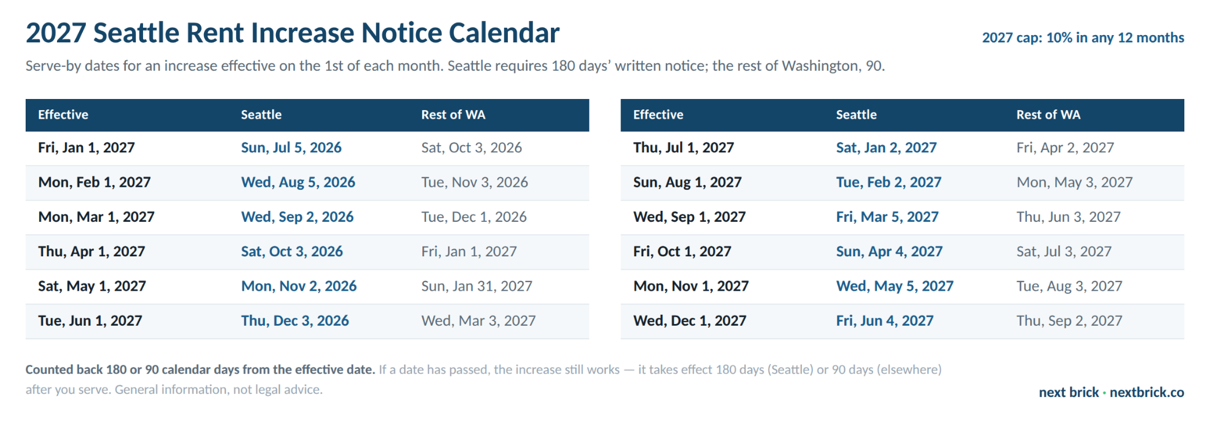
Seattle requires 180 days’ written notice before any housing cost increase, under Seattle Municipal Code 22.206.180. Counting back from common effective dates:
| Increase takes effect | Serve by — Seattle (180 days) | Serve by — elsewhere in WA (90 days) |
|---|---|---|
| January 1, 2027 | July 5, 2026 | October 3, 2026 |
| February 1, 2027 | August 5, 2026 | November 3, 2026 |
| March 1, 2027 | September 2, 2026 | December 1, 2026 |
| April 1, 2027 | October 3, 2026 | January 1, 2027 |
| May 1, 2027 | November 2, 2026 | January 31, 2027 |
| June 1, 2027 | December 3, 2026 | March 3, 2027 |
If a serve-by date is already behind you, the increase isn’t lost. It simply takes effect later: 180 days after the day you serve in Seattle, or 90 days elsewhere. A safe habit is to serve at least a week before the date on the table and keep proof of how and when the notice was delivered.
Before you serve anything, work through four steps.
STEP 1 Confirm an Increase Is Allowed at All
Four things can stop an increase before the percentage matters.
The first year. Under RCW 59.18.700, no increase is allowed during the first 12 months of a tenancy, unless the tenancy is exempt (see below).
A fixed-term lease. Under RCW 59.18.140(3)(a), an increase cannot take effect before the lease term ends.
A recent complaint. Under RCW 59.18.240 and RCW 59.18.250, an increase within 90 days after a tenant’s good-faith complaint to a government authority, or assertion of rights under the Residential Landlord-Tenant Act, is presumed retaliatory unless the landlord shows otherwise. RCW 59.18.250 adds an important exception: the presumption doesn’t arise if the rent increase notice states reasonable grounds for the increase. So write a short business reason into every notice, and keep a copy. (Our guide to how long a landlord has to fix something explains the repair complaints that start this 90-day window.)
An unresolved inspection. Seattle’s Department of Construction and Inspections states that an owner cannot raise housing costs when it has determined the unit does not meet the Rental Registration and Inspection Ordinance checklist.
Some tenancies are exempt from RCW 59.18.700 altogether
RCW 59.18.710 says rent increases “are not limited by RCW 59.18.700” for these tenancies, so neither the cap nor the first-year rule applies:
- •Units whose first certificate of occupancy was issued 12 or fewer years before the notice.
- •A single-family home the owner lives in, including one where the owner rents no more than two units or bedrooms.
- •A duplex, triplex or fourplex where the owner lived in one unit when the tenancy began.
- •A unit where the tenant shares a kitchen or bathroom with a resident owner.
- •Public housing and units owned by qualifying nonprofits and housing authorities.
- •Qualified low-income housing developments.
- •Properties built with federal low-income housing tax credits under an enforceable regulatory agreement with the Washington State Housing Finance Commission.
The owner-occupied exemptions have a limit that’s easy to miss.
Under RCW 59.18.710(2), they don’t apply if the owner is a real estate investment trust, a corporation, or a limited liability company with at least one corporate member. If you hold the property in an LLC, check who its members are before you claim an exemption.
An exemption doesn’t remove the notice rules. RCW 59.18.700(2) requires the supporting facts in the written notice, the state’s 90-day minimum under RCW 59.18.140 still applies, and so do Seattle’s 180-day notice, inspection and relocation rules.
STEP 2 Measure the Increase Against Two 10% Lines
The cap. The maximum rent increase in Seattle for 2027 is the statewide figure: 7% plus inflation or 10%, whichever is lower, in any 12-month period. The Department of Commerce publishes it each summer after the June Seattle-area CPI data. For 2027 the formula came to 11.53%, so the 10% ceiling applies from January 1 through December 31, 2027.
The cap limits the total of all increases in any 12 months, not each one separately. Washington law defines rent as the recurring and periodic charges identified in the rental agreement (RCW 59.18.030), and the state notice form reads “your total increase for rent and other recurring or periodic charges.” So treat a new monthly fee as part of the increase.
Fees face a second change. Seattle’s rental junk fee ordinance takes effect on July 1, 2027. It bans many recurring charges beyond rent, such as pet, administrative and common-area fees, and caps late fees at $10 a month. Our guide to the junk fee deadline explains why the 180-day notice makes the practical deadline much earlier.
Relocation assistance. Seattle’s Economic Displacement Relocation Assistance program (SMC chapter 22.212) applies when housing costs rise by 10% or more within 12 months, through one increase or several. According to the City, a household with income at or below 80% of area median income that moves out can receive up to three times its pre-increase monthly housing cost, collected from the landlord and distributed by the City. The tenant gives written notice of a move-out date before the increase takes effect and can apply up to 60 days after it does.
The two lines sit at the same number. A legal 10% increase can still create a relocation payment.
What that looks like in dollars
Here is how that plays out for Sam, who rents a two-bedroom condo in Roosevelt for $2,500 a month on a lease ending June 30, 2027:
| A 10% increase | A 6% increase | |
|---|---|---|
| New monthly rent | $2,750 | $2,650 |
| Extra rent over 12 months | $3,000 | $1,800 |
| Relocation exposure if an eligible tenant moves out | Up to $7,500 (3 × $2,500) | None from this increase alone |
| Seattle notice deadline for July 1 | January 2, 2027 | January 2, 2027 |
Sam and the condo are made up to illustrate the math. They are not real owners or tenants.
The larger increase earns $1,200 more over the year but opens a possible $7,500 payment plus a vacancy. Smaller increases add up, too: a 5% increase followed by a 6% increase within 12 months raises housing costs by 11.3%, crossing both lines even though neither step looked large.
The approach we recommend: price each renewal against both lines, not just the cap.
If you’d rather not run the numbers unit by unit, renewal pricing and notices are part of our Seattle property management.
Seattle rent increase laws treat month-to-month tenancies the same way on the cap, the first-year rule and notice. RCW 59.18.700(4)(b) adds one limit: rent for different lease types on the same unit may differ by no more than 5%.
Does Seattle Have Rent Control?
No. Under RCW 35.21.830, Washington cities and towns can’t enact or enforce ordinances that regulate the amount of rent charged, apart from narrow exceptions such as publicly owned and certain publicly assisted low-income housing. SDCI says it plainly: Seattle’s “housing cost increase rules are not rent control.”
So Seattle can’t set its own cap, and the statewide cap is the limit on how much rent can rise. What Seattle does control is the process around an increase: the 180-day notice, the inspection block and relocation assistance.
Five Common Misreadings of the Rules
Some guides that rank for these searches still repeat rules that are out of date or never were the law. Here is what the current text says.
| The claim | What the current text says |
|---|---|
| “Washington has no rent cap, so you can raise rent by any amount.” | From 2025, RCW 59.18.700 caps will increase at 7% plus inflation or 10%, whichever is lower. For 2027 that is 10%. |
| “Seattle needs only 60 or 90 days’ notice.” | 90 days is the state minimum. Seattle requires 180 days under SMC 22.206.180. |
| “A fixed-term lease can allow a mid-term increase if the lease says so.” | RCW 59.18.140(3)(a) says an increase may not take effect before the term ends. |
| “Posting the notice on the door or mailing it is enough.” | RCW 59.18.720 requires service under RCW 59.12.040, which starts with handing it to the tenant. Posting plus mailing is a last resort. |
| “A 10% increase is safe because it’s within the cap.” | It’s legal, but in Seattle it also reaches the relocation assistance line. |
STEP 3 Write and Serve the Notice
A Seattle rent increase notice must be served at least 180 days before the increase, under Seattle Municipal Code 22.206.180 as described by SDCI. Outside Seattle, the state minimum is 90 days under RCW 59.18.140. Either way, the notice itself has rules:
Use the state form. RCW 59.18.720 requires a notice substantially the same as the statutory form. The form states the effective date, the total increase as a percentage and in dollars per month, and the new monthly total. It also has checkboxes for any exemption you claim, which need supporting facts.
State your reason. Add a short, honest business reason for the increase, such as rising property taxes or insurance. It keeps the retaliation presumption from arising under RCW 59.18.250.
Attach the relocation notice when it applies. If the increase reaches 10% or more in 12 months, SDCI requires an Economic Displacement Relocation Assistance notice with it.
Serve it properly. RCW 59.18.720 requires service under RCW 59.12.040. Hand it to the tenant. If they’re away, leave it with a person of suitable age at the home and also mail a copy. Posting plus mailing is allowed only when no one suitable can be found. Keep a signed record of how and when you served it.
STEP 4 Keep the Proof
File the notice, the service record, any exemption documents and your written reason for the increase with the lease. If a tenant or the state later questions the increase, that file is your answer. If the increase reached 10%, also note the date 60 days after it takes effect: until then, an eligible tenant who moved out can still apply for relocation assistance.
If an Increase Breaks the Rules
Under RCW 59.18.700, a tenant facing an unauthorized increase must first give the landlord a written demand to reduce it. The tenant may end the tenancy before the increase takes effect by giving at least 20 days’ written notice, without fees.
If a court finds a violation of the cap, the notice form or the notice period, it must award excess rent paid, up to three months of the unlawful amount, and attorney’s fees. The Attorney General can also sue and seek civil penalties of up to $7,500 per violation.
Plan Your 2027 Renewals
Renewal negotiation and legal compliance are part of Next Brick’s Seattle property management. For pricing strategy, read how top Seattle property managers set rents, and for the whole leasing process, our 2026 checklist for renting out a Seattle house.
Start with the dates. then Contact our Seattle team to plan your renewals. Lease renewals are a flat fee; see our pricing.
Frequently Asked Questions
How much can a landlord raise rent in Seattle in 2027?
Up to 10% in any 12-month period for most units, under Washington’s statewide cap. No increase is allowed in the first 12 months of a tenancy unless the tenancy is exempt under RCW 59.18.710.
Does Seattle have rent control?
No. Under RCW 35.21.830, Washington cities can’t regulate the amount of rent, apart from narrow exceptions for publicly owned and certain publicly assisted housing. The statewide cap of 10% for 2027 is the limit. Seattle adds a 180-day notice rule and relocation assistance.
What are the Washington state rent increase laws in 2027?
Increases are capped at 7% plus inflation or 10%, whichever is lower, in any 12-month period; for 2027 that is 10%. Landlords must give at least 90 days’ written notice on the state form (180 days in Seattle). Unless the tenancy is exempt under RCW 59.18.710, no increase is allowed in the first 12 months.
How much notice does a Seattle landlord need to give for a rent increase?
At least 180 days’ written notice before any increase in housing costs, under Seattle Municipal Code 22.206.180. The state minimum of 90 days applies elsewhere in Washington.
Can I still raise rent if I missed the 180-day deadline?
Yes. The increase just takes effect later: at least 180 days after you serve the notice in Seattle, or 90 days elsewhere in Washington.
Does a 10% rent increase in Seattle trigger relocation assistance?
It can. Seattle’s Economic Displacement Relocation Assistance applies to increases totaling 10% or more within 12 months when an eligible household with income at or below 80% of area median income moves out.
Can a landlord raise rent during a fixed-term lease in Washington?
No. Under RCW 59.18.140, an increase cannot take effect before the lease term ends.
Do fees count toward the Washington rent cap?
Yes. Washington law defines rent as the recurring and periodic charges identified in the rental agreement, and the state notice form covers “rent and other recurring or periodic charges,” so treat new monthly fees as part of the increase.
Can an LLC owner claim the owner-occupied exemption?
Only if no member of the LLC is a corporation. Under RCW 59.18.710(2), the owner-occupied exemptions don’t apply to REITs, corporations, or LLCs with at least one corporate member.
This article is general information, not legal advice, and does not create an attorney-client relationship. Rent increase rules change, and exemptions depend on specific facts. Confirm current requirements with the Washington Department of Commerce, Seattle SDCI, or a licensed Washington attorney before serving a notice.
Sources
- •RCW 59.18.700 — Rent increase limits
- •RCW 59.18.710 — Exempt tenancies
- •RCW 59.18.720 — Rent increase notice form
- •RCW 59.18.030 — Definitions
- •RCW 59.18.140 — Notice and fixed-term leases
- •RCW 59.18.240 — Retaliation prohibited
- •RCW 59.18.250 — Presumption of retaliation
- •RCW 59.12.040 — Service of notice
- •RCW 35.21.830 — Rent control preemption
- •WA Department of Commerce, HB 1217 Landlord Resource Center
- •City of Seattle SDCI, Housing Cost Increases
- •Seattle Municipal Code 22.206.180 (Municode)
- •City of Seattle, Economic Displacement Relocation Assistance
- •Seattle Municipal Code chapter 22.212 (Municode)
- •City of Seattle, Office of the Mayor, Rental Junk Fees Legislation FAQ
