
The best time to rent out a house in Seattle is just ahead of summer, when the most renters move.
Winter is a smaller market, but it is still a market.
The cost that repeats year after year comes from a lease that ends in December.
What the Moving Data Shows
A U.S. Census Bureau analysis of moves made in 2009, presented in 2011, found June was the most popular month to move, with about 11% of all moves, followed by August at about 10%. December, February and March were the slowest months, each drawing only about 7% of moves.
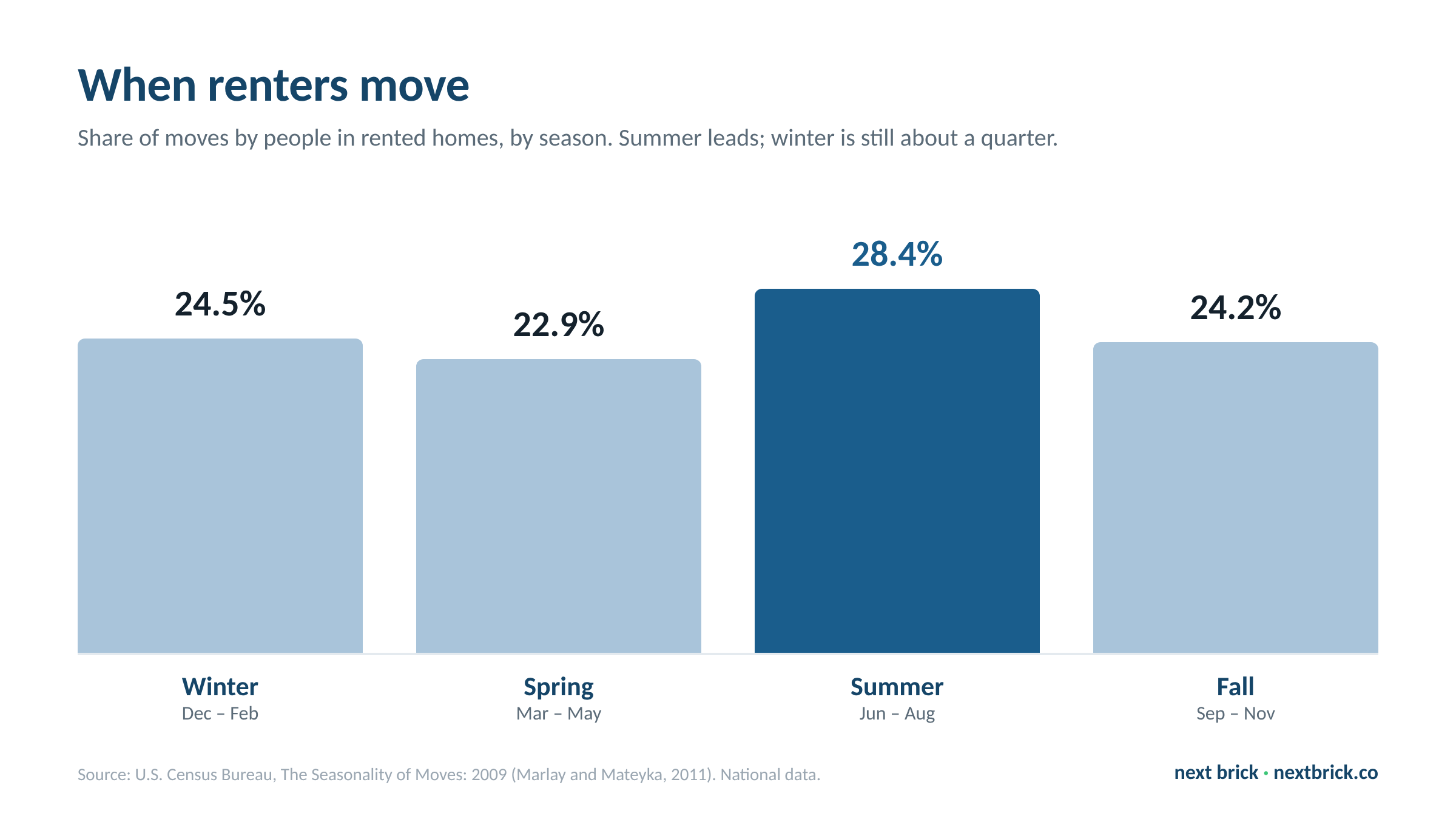
Look only at people living in rented homes, though, and the seasons draw closer together:
| Season (Census definition) | Share of moves by people in rented homes |
|---|---|
| Winter (December to February) | 24.5% |
| Spring (March to May) | 22.9% |
| Summer (June to August) | 28.4% |
| Fall (September to November) | 24.2% |
Renters’ moves were spread almost evenly across winter, spring and fall. The data is national and more than 15 years old, so read it as a pattern rather than a forecast. The pattern still points one way: list just ahead of summer if you can, expect December to be thin, and expect a winter listing to draw fewer applicants.
Winter Myths vs. the Data
| What owners often hear | What the data and the law say |
|---|---|
| “Nobody rents in winter.” | About a quarter of moves by people in rented homes happened from December to February in the Census data. |
| “Cut the rent now and raise it back next year.” | A new tenant’s rent can’t rise at all in the first 12 months unless the home is exempt (RCW 59.18.700 and 59.18.710). After that, most increases are capped at 10% for 2027, and the winter price is the base. |
| “Let the lease lapse in December and restart it in June.” | In Seattle, declining to renew a term lease needs a just cause. Resetting your calendar is not one. |
| “A month-to-month tenant can leave on any day.” | The tenant must give at least 20 days’ written notice before the end of a rental period (RCW 59.18.200), with an exception for military orders. |
Why Seattle’s Calendar Bends the Pattern
National averages flatten local rhythms, and Seattle has a few of its own.
- The school year. Seattle Public Schools’ 2026–27 calendar starts classes for grades 1–12 on September 2, 2026, runs winter break from December 21 to January 1, and ends on June 21, 2027. Families with children may plan moves around those dates.
- University quarters. The University of Washington’s 2026–27 calendar starts instruction on September 30, January 4 and March 29. Near campus, each quarter start can open a small leasing window, including one in early January.
- Daylight. Around the winter solstice, Seattle gets about 8 hours 25 minutes of daylight, with sunrise near 7:54 a.m. and sunset near 4:20 p.m. (timeanddate.com). After-work showings happen in the dark, so schedule photos and showings for late morning to early afternoon.
The same calendar cuts the other way for renters: fewer rivals in winter, but fewer homes to choose from too.
The Math of a Winter Vacancy
Morgan owns a three-bedroom house in Wedgwood that rents for $3,400 a month. The tenant moves out on December 31, and Morgan has a choice. (Morgan is a made-up example to teach the math, not a real owner or property.)
| Hold at $3,400 | Price at $3,300 | |
|---|---|---|
| Rent lost per vacant day | About $112 | About $108 |
| Cost of three extra vacant weeks | About $2,350 | None, if it leases on schedule |
| Rent given up over a 12-month lease | None | $1,200 |
The break-even is about 11 days.
A $100 cut costs $1,200 over a year, roughly 11 vacant days at $3,400 rent. If the holding firm would add more than that, the lower price wins. If the home would lease on time anyway, the discount is money given away.
Mortgage, utilities and HOA dues keep running either way, which widens the gap. Next Brick’s vacancy calculator lets you add HOA dues, utilities and other monthly costs.
If you’d like to talk through your own number, book a call with our Seattle team.
Is It Cheaper to Rent in the Winter?
Often a little, but not reliably. We found no official Seattle data on seasonal rent levels. Apartment List’s national rent report (October 28, 2026) notes that fewer renters move in fall and winter, so owners offer modest discounts to fill vacant units, and that time on market rises in the slow season.
Two cautions. That index tracks apartments, and single-family houses can move differently. And a city-wide median can’t tell you what your home will lease for; recent comparable leases can. For when a price cut on a live listing makes sense, see when to consider reducing the rent on your rental ad.
Pricing When the Market Is Thin
The approach we recommend comes down to three moves:
- Price from what leased recently, ideally leases signed in the last 90 days. Summer asking prices came from a busier season.
- Pick a review date before you list, so any decision to adjust price, photos or showing access isn’t made under pressure.
- Protect the base rent. Washington’s rent stabilization law caps increases at 7% plus inflation or 10%, whichever is lower, in any 12-month period, and the Department of Commerce set that figure at 10% for 2027. Some homes are exempt, including those whose first certificate of occupancy was issued 12 or fewer years before the increase notice (RCW 59.18.710). For everyone else, a winter cut to base rent becomes the starting point for next year’s capped increase, so a smaller or temporary adjustment may serve you better.
If you use a move-in concession instead, write its terms clearly into the lease. Washington’s rent-increase notice rules treat rent as all recurring and periodic charges (RCW 59.18.720), so a concession that ends can look like an increase. Confirm with counsel how it will be treated at renewal.
The Real Fix: Where Your Lease Ends
A single winter vacancy is a cost you can calculate. A lease that ends in December every year repeats the risk. The fix is to choose the lease length at signing so the end date lands in late spring. If the tenant moves, the home comes back to market ahead of the June peak; if they stay, you renew outside winter.
| Move-in date | Lease ending May 31, 2027 | Lease ending May 31, 2028 |
|---|---|---|
| November 1, 2026 | 7 months | 19 months |
| December 1, 2026 | 6 months | 18 months |
| January 1, 2027 | 5 months | 17 months |
| February 1, 2027 | 4 months | 16 months |
Under this plan, you list in spring, ahead of a late-spring or early-summer move-in. Five rules shape how far you can take it:
- No increase in year one. Washington bars any rent increase during the first 12 months of a tenancy (RCW 59.18.700), unless the home is exempt under RCW 59.18.710. A tenant who moves in between November and February on a lease ending May 31 can’t be offered a renewal at a higher rent. If you expect to raise rent at the first renewal, choose the 16-to-19-month option in the table, so the renewal falls after the first year.
- Parity between lease options. If you offer more than one lease type for the same home, RCW 59.18.700(4) limits the rent difference to 5%, and that difference cannot push rent above the annual increase cap. It also bars payment terms or other material conditions that are more burdensome for a month-to-month agreement than for a fixed-term one, or the reverse. Our comparison of month-to-month vs. fixed-term leases covers the trade-offs.
- Renewal is required. Seattle requires owners to give tenants a reasonable offer of renewal 60 to 90 days before a term lease ends (SMC 7.24.030), and the tenant has 30 days to respond. Declining to renew requires one of the causes in the city’s Just Cause Eviction Ordinance. Letting a lease lapse to reset the calendar is not one of them.
- The rent notice comes first. Seattle requires 180 days’ written notice before any housing cost increase (SMC 22.206.180). For an existing tenant whose renewal starts June 1, 2027 at a higher rent (and who will have been in the home at least 12 months by then), that notice is due by December 3, 2026, well before the renewal offer window of March 2 to April 1, 2027. If increases total 10% or more within 12 months, Seattle also requires you to attach the City’s Economic Displacement Relocation Assistance (EDRA) notice, and an eligible tenant who moves out may qualify for relocation assistance under that program.
- Watch the 90-day retaliation window. If a tenant made a good-faith complaint, such as a repair request, a rent increase within the next 90 days can be presumed retaliatory unless the increase notice states reasonable grounds for it (RCW 59.18.250). Our guide to how long a landlord has to fix something in Washington covers the repair side.
With a current tenant, then, moving the end date takes the tenant’s agreement.
The Seattle Rules That Run on a Calendar
- Winter eviction defense. A Seattle renter can raise a defense to an eviction that would require moving out between December 1 and March 1 if the household is moderate income as Seattle’s code defines it (SMC 23.84A.016, quoted in the 2022 Court of Appeals decision) and the unit is owned by a person who owns more than four rental housing units in Seattle (SMC 22.205.080). The defense doesn’t cover every cause: the City lists exceptions, including owner or family move-in, sale of a single-family home, and units the City has found unsafe. Check the City’s summary of eviction defenses and the ordinance before serving any notice that ends a tenancy in winter.
- School-year eviction defense. A similar defense covers households with a child in school (daycare through high school) and tenants who work at a school in Seattle, when the move-out would fall during the Seattle Public Schools year, September to June (SMC 22.205.110). If you ever need to end a tenancy for cause, note that a May 31 lease end falls inside that window. Like the winter defense, it has exceptions, including owner or family move-in and units the City has found unsafe.
- Month-to-month exits. A Seattle tenant on a month-to-month agreement can leave at the end of any rental period, December included, by giving at least 20 days’ written notice before that period ends (RCW 59.18.200). Members of the armed forces, and their spouses or dependents, may give less notice when deployment or change-of-station orders don’t allow 20 days.
- First in time, all year. Seattle’s first-in-time rule requires screening complete applications in the order received and offering the lease to the first qualified applicant, whatever the season.
Before You List This Winter
- Photograph at the brightest time of day, showing the home as it is now.
- Keep the heat on while the home is vacant.
- Clear leaves from gutters, walkways and the entry.
- Publish written screening criteria before the listing goes live.
- Write down your price review date.
- Describe the home and its features, and leave out who you’d like to rent to. Federal, state and Seattle fair housing laws all cover rental ads (42 U.S.C. 3604(c), RCW 49.60.222, SMC 14.08).
For the wider picture, see how top Seattle property managers set rents and our 2026 checklist for renting out a Seattle house.
Listing This Winter? How Our Tenant Placement Guarantee Works
Next Brick’s leasing service covers marketing, screening and weekly leasing activity updates. Owners on full management are also covered by our Tenant Placement Guarantee: if we don’t secure a tenant within 30 days, your first month’s management fee is waived. It doesn’t replace lost rent; it puts part of our fee on the line if the home sits.
Terms apply and the owner signs a separate guarantee agreement: the 30 days start once the home is move-in ready and listed, the rent must be set from market data and our recommendation, the home must meet safety and habitability standards, and the guarantee doesn’t apply if an owner declines qualified applicants or delays approvals or repairs.
Deciding whether to list now or wait?
Book a consultation with our Seattle team →
Or see how our pricing works.
Frequently Asked Questions
What is the best time to rent out a house in Seattle?
Just ahead of summer. June was the most popular moving month in Census data, at about 11% of moves. Listing ahead of a late-spring or early-summer move-in date puts your home in front of the largest pool of renters.
Is it a good time to rent out your house in winter?
It can be. People in rented homes made about a quarter of their moves from December to February in Census data, though December, February and March each drew only about 7% of all moves. Expect fewer applicants, price from recent leases, and set a review date before you list.
Is it cheaper to rent in the winter?
Often a little, but not reliably. Apartment List’s October 2026 national report notes that owners offer modest discounts in fall and winter, when fewer renters move. We found no official Seattle data on seasonal rent levels, and each home’s price depends on its own comparables.
Can I change my tenant’s lease end date to spring?
Only by agreement. Seattle requires a reasonable renewal offer 60 to 90 days before a term lease ends, and not renewing requires a just cause under city law.
Can a month-to-month tenant in Seattle move out in December?
Yes, at the end of a rental period. The tenant must give at least 20 days’ written notice before that period ends (RCW 59.18.200). Members of the armed forces with qualifying orders may give less.
This article is general information, not legal advice, and does not create an attorney-client relationship. Seattle and Washington rental rules change, and outcomes depend on specific facts. Confirm current requirements with the City of Seattle, the Washington Department of Commerce, or a licensed Washington attorney.
