
Short answer. The Seattle winter eviction ban is not a blanket ban. It's a defense a qualifying renter can raise in court.
It applies when an eviction would force the household out between December 1 and March 1, the household meets an income test, and the landlord owns more than four rental units in Seattle (SMC 22.205.080, Ordinance 126041).
A second defense covers households with students or school staff for the whole school year, September to June, with no size limit on the landlord (SMC 22.205.110, Council Bill 120046).
Rent is still owed through both.
Most people searching this have one of two worries. Renters want to know if they can be put out in January. Owners want to know if a missed December payment means waiting until spring. Both questions have real answers, and the answers turn on three details: who owns the building, who lives in the unit, and why the tenancy is ending.
This guide covers the Seattle winter eviction ban and the school-year rule together, because in practice they overlap. It also covers the Seattle eviction laws, state laws and federal rules that sit underneath them, and what an owner can do now, before December 1.
General information, not legal advice. Seattle's code and Washington law change, and eviction cases turn on facts. Talk to a landlord-tenant attorney before serving a notice or filing.
The Two Seattle Rules at a Glance
| Winter defense | School-year defense | |
|---|---|---|
| Code | SMC 22.205.080 | SMC 22.205.110 |
| When it applies | Move-out would fall between Dec 1 and Mar 1 | Move-out would fall during the Seattle Public Schools academic year (roughly Sept to June) |
| Who it protects | Households under the income line (see below) | Households with a child or student, a parent or guardian of one, or someone who works at a Seattle school |
| Landlord size | Only landlords who own more than four rental units in Seattle | No size threshold |
| Income test | Yes | None |
| Rent still owed? | Yes | Yes |
| Owner move-in exempt? | Yes | Yes |
| Sale of a single-family home exempt? | Yes | No |
Sources: SMC 22.205.080 and 22.205.110, and the City's Defenses to Eviction pages (checked 13 November 2026).
What the Seattle Winter Eviction Ban Actually Does
It changes when an eviction can be completed, not whether it can happen.
Seattle passed the rule in February 2020 as Ordinance 126041. Landlords challenged it in the Washington Court of Appeals, and the court upheld it. The court described how it works plainly: a landlord can still file, get an order finding the tenant in unlawful detainer, and ask the court to schedule the writ of restitution for after March 1 (Rental Housing Association of Washington v. City of Seattle, No. 82469-4-I, Wash. Ct. App., June 21, 2022).
The same opinion is clear on money. The ordinance does not remove the tenant's obligation to pay rent, and it does not forgive or reduce what's owed. In the same case, ruling on a separate COVID-era rule, the court noted that unpaid rent can accrue interest at 12% a year under RCW 19.52.010 unless a different rate was agreed in writing. Interest on a court judgment is set by a different statute (RCW 4.56.110), so ask your attorney what applies.
In October 2026 the Court of Appeals revived a landlord's lawsuit claiming several Seattle rental rules, including this one, take property without compensation (GRE Downtowner LLC v. City of Seattle). The case goes back to trial court; the winter defense remains in force this winter.
Three conditions, all required
The code text, as quoted by the court, makes the defense available only if all three are true:
- Timing. The eviction would make the household leave at any time from December 1 to March 1.
- Income. The household is under the code's income line (more on this below).
- Owner size. The unit is owned by someone who owns more than four rental housing units in Seattle. An ownership interest counts, so partial ownership through a partnership or co-ownership can add up. One caution: the City's web pages word this threshold loosely, describing landlords with "less than 4 properties" as exempt. The code says more than four units. If you own exactly four, get advice before you rely on the exemption.
Miss one, and the defense doesn't apply.
The income line: at or below area median income
This is the detail worth reading slowly, because the code and the City's own guidance don't use the same number.
The ordinance ties eligibility to a "moderate-income household as defined in Section 23.84A.016." When the Court of Appeals quoted that definition in 2022, it meant a household whose income does not exceed median income: 100% of area median income. In 2023, the City removed that definition from SMC 23.84A.016 (Ordinance 126855) but didn't update the winter-defense section, which still points to it. The City's renter guidance page describes the line as 80% of AMI (Defenses to Eviction).
So no current code text settles the number. The 100% line has the stronger written basis, because it's what the ordinance meant when it passed and what the court applied. Seattle's Office of Housing publishes income limits each year; the current figures took effect May 15, 2026 (Seattle Office of Housing, 2026–27 rental income limits). For context, landlords' evidence in the 2022 case put the 2019 median for a family of four at $108,600. The line has risen a lot since then.
| Household size | 100% of AMI (the code's line as passed) | 80% of AMI (the City's guidance) |
|---|---|---|
| 1 person | $115,100 | $92,080 |
| 2 people | $131,600 | $105,280 |
| 3 people | $148,000 | $118,400 |
| 4 people | $164,400 | $131,520 |
| 5 people | $177,600 | $142,080 |
| 6 people | $190,800 | $152,640 |
So a household of four earning $150,000 is over the City's 80% figure but under the 100% line. Our advice to owners: plan around the 100% column, and don't assume a tenant is over the line because they earn a solid salary. If income matters to your decision, an attorney should check the code as it reads on the day you act.
What the winter defense does not cover
According to the City's guidance for landlords, the winter defense doesn't apply when the tenancy ends for these reasons:
- The owner or an immediate family member will move in (90 days' notice; the City may require the owner to certify the move-in).
- The owner is selling a single-family house, meaning a detached structure on a permanent foundation (90 days' notice).
- The City has ordered the owner to stop renting an unpermitted unit or to reduce the number of occupants (20 days' notice, and the tenant may be owed relocation assistance), or to vacate a unit declared unsafe by emergency order.
- The tenant was served a 3-day notice for criminal activity, waste, nuisance, or an imminent hazard. A criminal-activity notice must be sent to the City with supporting facts, such as a police report, for review and recording.
So the rule mainly affects evictions for unpaid rent and for lease violations.
The Seattle School-Year Eviction Ban (No Size Limit)
Here's the part that catches small landlords: the school-year defense has no owner-size threshold. The owner of one condo can be affected.
The City Council passed it in June 2021 as Council Bill 120046, by a 6–1 vote (The Urbanist). It gives a defense when an eviction would make the household leave during the Seattle Public Schools academic year, from the first to the last day the district sets for grades 1–12 (SMC 22.205.110). For 2026–27, that's September 2, 2026 to June 21, 2027 (Seattle Public Schools).
Who counts
Under SMC 22.205.110, the household qualifies if it includes:
- A child or student, meaning someone under 18 or enrolled in a school. "School" includes child care, early learning and Head Start programs, so this runs from daycare through high school.
- A person with legal custody of a child or student, such as a parent, step-parent, adoptive parent, guardian or foster parent.
- An educator, meaning anyone who works at a school in Seattle as an employee or independent contractor. The code's list runs from teachers, substitutes and paraprofessionals to counselors, school nurses, custodians, cafeteria workers and maintenance workers. Treat anyone on a school payroll or contract as covered.
What it does not cover
The code lists these exemptions: owner or family move-in, a City order on an unpermitted unit, an order to reduce occupants or discontinue an accessory dwelling unit, an emergency vacate order, an owner who shares the home or lives on the same lot, and notices for criminal activity, drug-related nuisance or an unlawful business (SMC 22.205.110).
Notice what's missing. Selling a single-family home isn't on the school-year list, even though it's on the winter list. If you plan to sell a tenant-occupied house and the household includes a student or school employee, get legal advice early on the timing of your 90-day notice. Our earlier post on selling a rental home with tenants in place covers the rest of that process.
How the Two Rules Overlap on the Calendar
The school year contains the winter window. For a household that qualifies for both, the winter rule adds little. For a household that qualifies only for the school-year rule, the window is long.
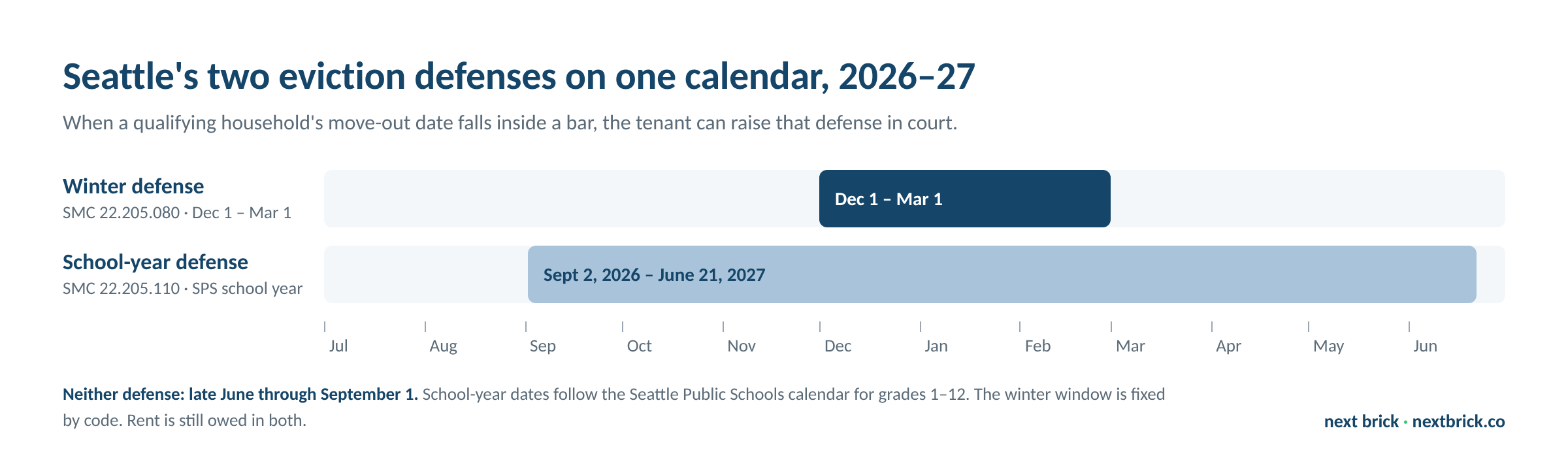
School-year dates follow the Seattle Public Schools calendar, so check the district's published dates for the year in question. The winter window is fixed by code.
For a family household, the realistic window to complete an eviction for unpaid rent is summer.
That's the single most useful planning fact in this whole topic.
Both rules stop at the city line. They are City of Seattle rules. Bellevue, Kirkland, Redmond and other Eastside cities write their own tenant rules. Kirkland, for example, has its own tenant protection ordinance covering rent-increase notice and move-in costs (Ordinance O-4810, 2022). If your rental is outside Seattle, check that city's code before you rely on this calendar.
Five Common Misreadings of the Winter Rule
Search for this topic and you'll find confident answers that don't match the code. Here are five worth correcting:
| What you'll read online | What the code and the court say |
|---|---|
| "It runs November through March." | The code window is December 1 to March 1. A November move-out date isn't covered by the winter defense, though the school-year defense may still apply. |
| "It only protects tenants of small landlords." | It's the reverse. The winter defense applies only when the owner has an interest in more than four Seattle units. Small landlords are outside it, but not outside the school-year rule. |
| "It ends February 28." | The code runs through March 1. Plan writ dates after that. |
| "Landlords can't file an eviction in winter." | Filing is allowed. The court can enter judgment and set the writ for after March 1. |
| "Tenants can skip rent until spring." | The Court of Appeals held the rule doesn't forgive or reduce rent, and unpaid rent can carry interest. |
State and Federal Rules That Still Apply in Seattle
Seattle tenant laws sit on top of Washington's statewide eviction rules and a few federal ones. Getting the local rule right isn't enough on its own. For the full statewide process, step by step, see our guide to Washington eviction laws for landlords.
Washington requires a reason for almost every termination. Since 2021, a landlord may not end most tenancies except for causes listed in RCW 59.18.650. Seattle's own just cause rules, in SMC chapter 22.205, apply on top. A landlord who removes a tenant in violation of the state statute owes the greater of the tenant's economic and noneconomic damages or three times the monthly rent, plus attorney fees and court costs (RCW 59.18.650(4)). A new version of the statute takes effect January 1, 2028, but the change is a cross-reference in the condominium conversion cause. It doesn't touch nonpayment, lease violations or owner move-in.
Unpaid rent starts with a 14-day notice. For residential tenancies, the pay-or-vacate period is 14 days after service (RCW 59.12.030(3)), using the state's required form (RCW 59.18.057).
How you serve the notice matters. If you can't hand the notice to the tenant, you leave a copy with someone of suitable age and also mail a copy from within Washington. If no one is there, you post it on the door, hand a copy to a resident if possible, and mail a copy. Service by mail adds five days before you can file, and every termination notice must state the date by which the tenant must vacate or comply (RCW 59.12.040, amended in 2025 and 2026). From July 2025 to June 2026 the mailed copy had to go by certified mail; a 2026 law (HB 2664) removed that requirement.
Courts can pause an eviction even outside winter. After a judgment for unpaid rent, a court may stay the writ for up to 90 days on a payment plan, after weighing factors such as hardship and payment history (RCW 59.18.410(3)). Tenants who qualify as indigent (generally at or below 200% of the federal poverty level) have a right to an appointed attorney, subject to funding (RCW 59.18.640).
An unregistered rental can stop an eviction. The City lists failure to register a rental under the Rental Registration and Inspection Ordinance (RRIO) as a defense to eviction (Renting in Seattle). Our 2026 checklist for new Seattle landlords covers RRIO fees and deadlines.
Federal: a 30-day notice for some properties. If the property has a federally backed mortgage (for example, one owned or guaranteed by Fannie Mae, Freddie Mac, or FHA) or takes part in certain federal housing programs, the CARES Act requires 30 days' notice before a tenant must vacate. In February 2025, the Washington Supreme Court held that this applies only to evictions for nonpayment of rent (Housing Authority of King County v. Knight, No. 102905-5; 15 U.S.C. § 9058(c)). If you're not sure whether your loan qualifies, ask your servicer.
Federal: families are a protected class. The Fair Housing Act bars discrimination based on familial status, meaning households with children under 18 (42 U.S.C. § 3604). Turning away families because of the school-year rule would create far bigger problems than the rule itself. We don't recommend any screening approach built around avoiding it.
Three Worked Examples
These examples are made up to show how the rules interact. They are not real cases.
Example 1: A six-unit owner and a December shortfall
An owner with six Seattle units has a tenant at $2,800 a month who misses December 1 rent. The household's income is under the line and there are no school-age children. The owner serves a 14-day notice, but any move-out would land inside the winter window, so the tenant can raise the defense.
The earliest the eviction can be completed is after March 1. By then, December through February rent totals $8,400, and March rent is due too. The debt is still owed, but the vacancy, turnover, and collection risk stack up. Our vacancy calculator shows what three empty months cost you.
Example 2: A one-condo owner who thinks the rules don't apply
An owner rents out a single condo. She knows she owns fewer than five units, so the winter defense doesn't apply. But her tenant works as a paraprofessional at a Seattle elementary school. If rent stops in October, the school-year defense can push a completed eviction toward late June. Her size doesn't protect her here.
Example 3: A fall shortfall, handled two ways
An owner has three Seattle units, so the winter defense doesn't apply. One unit rents for $3,000 a month to a family with a second grader. The family misses October 1 rent after a job loss.
Path A: notice first, talk later. The owner serves a 14-day notice and files. The school-year defense applies, so a completed move-out may not come until late June. By then up to nine months of rent, about $27,000, could be unpaid. It's still owed, but it's a judgment the owner has to collect from a household that just lost income.
Path B: the approach we recommend. The owner calls in the first week of October. The family applies for emergency rental assistance, and the owner accepts the written pledge when it comes (Washington law requires this in many situations). The owner offers a written plan for whatever assistance doesn't cover, spread over three months. If assistance covers none of it, that's $1,000 on top of each month's rent. If the plan holds, the arrears are cleared by January and the unit never sits empty. If it fails, the owner serves a proper 14-day notice then. The school-year defense still applies, so the timeline is no worse than Path A, and the owner has collected some rent and kept a working relationship in the meantime.
The law doesn't change between the two paths. What changes is how fast the owner acted.
All three examples come down to the same habit: knowing who lives in each unit and acting before a protected window opens. That tracking is part of our property management service. You can see our management pricing before you decide.
What This Means for Renters, Owners, and Property Managers
For renters. These are defenses you raise in court, not automatic stays. They don't erase rent. If you receive an eviction summons, respond by the deadline and ask about a free attorney through Washington's right-to-counsel program. The Renting in Seattle helpline is 206-684-5700.
For owners. The real cost isn't the law, it's the delay. A December default can mean three to four months of lost rent before possession, and a fall default in a school household can mean much longer. The owners who handle this best act early and keep clean records.
For property managers. The job is mostly calendar and paperwork: knowing who lives in each unit, tracking school-year dates, serving notices in the form and manner the statute now requires, and checking RRIO status before any notice goes out.
What Owners Can Do Before December 1
- Check your count. Add up every Seattle rental unit you hold an ownership interest in. More than four means the winter defense can apply.
- Confirm RRIO registration is current. An unregistered unit undercuts any eviction, in any season.
- Act on arrears early, and kindly. A friendly reminder in the first days of a missed payment can fix the problem before any legal clock starts.
- Point tenants to rent help. Washington law requires landlords to accept a written pledge of emergency rental assistance from a government or nonprofit source in many situations (RCW 59.18.410(2)). Helping a tenant get it is usually faster than any court date.
- Consider a written repayment plan. Getting paid over three months generally beats waiting four for possession.
- Serve notices correctly the first time. Use the state 14-day form, list the vacate-or-comply date, and follow the current mailing rule. A defective notice means starting over, sometimes into the next protected window.
- Plan move-ins and sales with the calendar in mind. Owner move-in is exempt from both defenses. Selling a single-family house is exempt only from the winter one.
- Talk to counsel before filing. Especially if income, household makeup, or your unit count is unclear.
If you'd rather not track this yourself, it's part of what we handle for owners in our rent collection and eviction support services, alongside careful resident screening. For tenants we screen and place, our Eviction Guarantee covers up to $2,000 in legal fees if an eviction becomes necessary in the first 12 months of the lease (terms apply).
Frequently Asked Questions
Is there a winter eviction ban in Seattle?
Yes, but it works as a court defense, not an outright ban. It protects households under the code's income line from having to move out between December 1 and March 1, when the landlord owns more than four rental units in Seattle.
Can a landlord evict a tenant in winter in Seattle?
Sometimes. The winter defense doesn't apply to small landlords, to tenants over the income line, or to tenancies ending for owner move-in, sale of a single-family home, criminal activity, nuisance, or certain City orders.
Does a tenant still have to pay rent during the winter eviction ban?
Yes. The Washington Court of Appeals confirmed in 2022 that the rule doesn't forgive or reduce rent. Unpaid rent remains a debt the landlord can pursue.
Does the winter eviction ban apply to small landlords?
No. It applies only when the owner has an ownership interest in more than four rental housing units in Seattle. The school-year defense, by contrast, has no size threshold.
Can a landlord evict during the school year in Seattle?
Not usually, if the household includes a student, a child's parent or guardian, or someone who works at a Seattle school. The defense runs for the Seattle Public Schools academic year, roughly September to June, with exemptions such as owner move-in.
Who counts as an educator under Seattle's school-year rule?
Anyone who works at a school in Seattle as an employee or independent contractor, under SMC 22.205.110. The code's list runs from teachers, substitutes and paraprofessionals to counselors, school nurses, custodians, cafeteria workers and maintenance workers.
Can I file an eviction in December in Seattle?
Yes. Filing isn't barred. The court can find the tenant in unlawful detainer and schedule the writ of restitution for after March 1 if the winter defense applies.
Does the winter eviction ban apply outside Seattle city limits?
No. SMC 22.205.080 and 22.205.110 are City of Seattle rules. Bellevue, Kirkland, Redmond and other Eastside cities set their own rules, so check the local code where the property sits.
Can I evict in winter to move into my own home?
Yes. Owner or immediate family move-in is exempt from both Seattle defenses, with 90 days' written notice. You must actually move in; state law creates a rebuttable presumption the owner did not act in good faith if you or your family don't occupy the unit for at least 60 consecutive days within the 90 days after the tenant leaves.
What is the income limit for the Seattle winter eviction ban?
The ordinance covers a "moderate-income household," which the code defined as income at or below area median income when it passed: $164,400 for a household of four in 2026–27, per the Seattle Office of Housing. The City's renter guidance says 80% of AMI, and the definition the code points to was removed in 2023, so confirm the current line with an attorney before relying on it.
What notice is needed to evict for unpaid rent in Washington?
A 14-day pay-or-vacate notice on the state form. It must state the date to pay or vacate, and if served by mail, it must be mailed from within Washington, with five extra days before filing.
The Bottom Line
The Seattle winter eviction ban and the school-year rule don't stop owners from collecting rent or ever regaining their property. They move the finish line. For qualifying households, that can push a completed eviction for unpaid rent into summer.
The fix is the same for everyone: know your unit count and your tenants' situation, keep RRIO current, respond to missed rent in the first week, and get the notices right.
Want a second set of eyes on your Seattle rental before December?
Talk to our Seattle property management team →
Or get in touch.
