
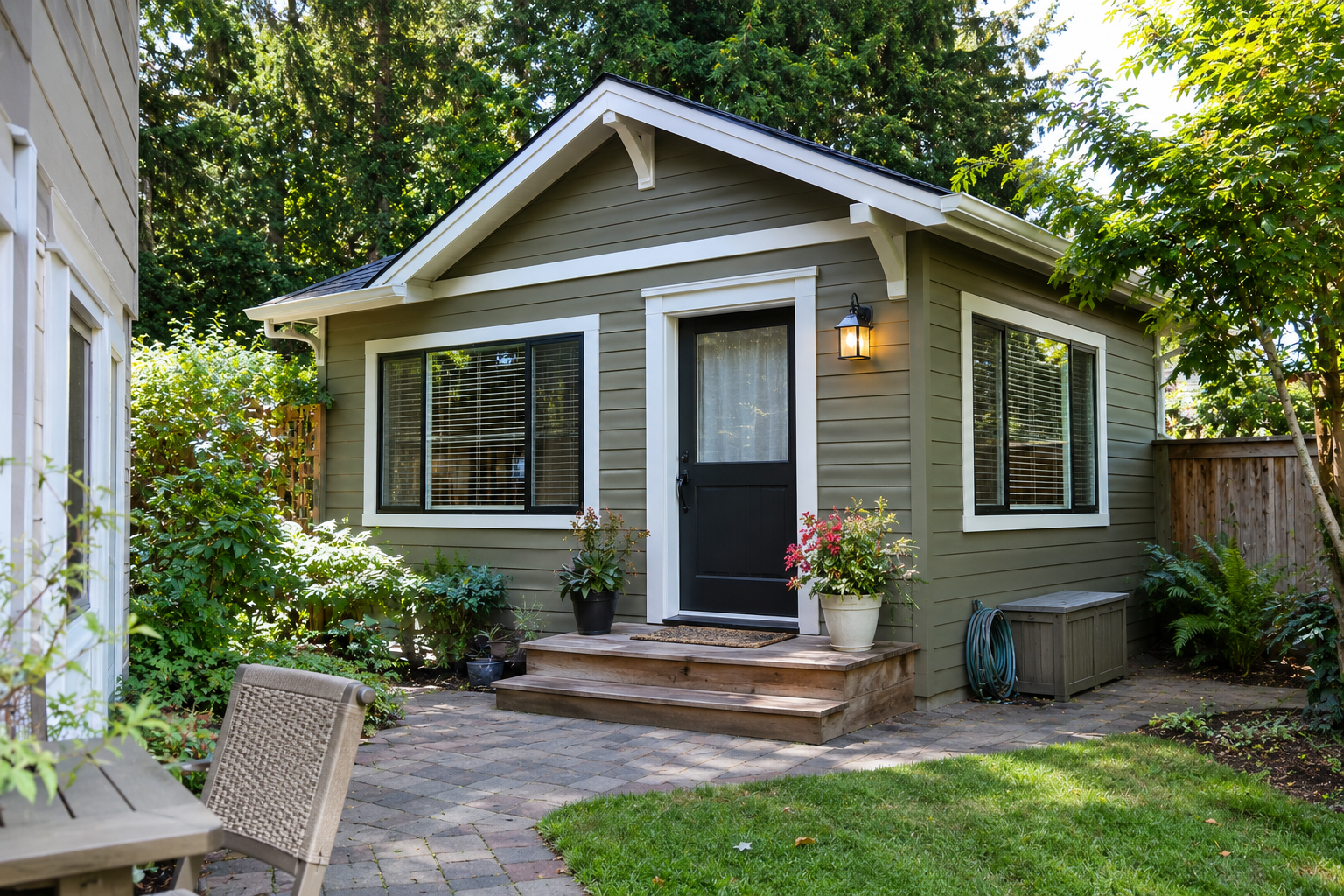
Short answer. Washington State ADU laws (from HB 1337, passed in 2023) let you build two accessory dwelling units on most single-family lots in urban growth areas and rent them out without living on site.
The catch is the state rent cap. If you live on the property and rent no more than two units, your ADU is exempt. Move out, and the cap applies unless the unit is within 12 years of its first certificate of occupancy.
Seattle adds rental registration on top.
Washington State ADU Laws at a Glance
| Rule | State law | Seattle | Bellevue | Kirkland |
|---|---|---|---|---|
| ADUs per lot | At least two (RCW 36.70A.681) | Two, within the total homes allowed on the lot (SMC 23.42.022) | Up to two (LUC 20.20.120) | Two; one on Residential-L shoreline lots (KZC 115.07, 83.200) |
| Must the owner live on site? | Cities can’t require it | Can’t be required (state law) | No longer required | Can’t be required (state law) |
| Size | Cities can’t cap below 1,000 sq ft | 1,000 sq ft; 1,200 with 3+ bedrooms; 1,500 on some Lowrise lots (SMC 23.42.022) | 1,200 sq ft | 1,200 sq ft |
| Parking | None within a half mile of a major transit stop; otherwise at most one per unit on lots under 6,000 sq ft, two on larger lots | Not required (SMC 23.42.022) | Changing: Ordinance 6947 (effective Nov 24, 2026) replaces the ADU parking rule with new citywide rules | None required (Ordinance O-4948, September 2026) |
| Owned separately? | A condo can’t be barred from separate sale just because it was built as an ADU | Yes; median ADU condo sold for $757,500 in 2022 (OPCD) | Yes | Yes, except on Residential-L shoreline lots |
We checked each city’s code in November 2026. Bellevue’s code now includes Ordinance 6931 and is current through Ordinance 6935; Ordinance 6947, effective November 24, 2026, rewrites its parking rules. Kirkland’s Ordinance O-4948 (September 2026) removed ADU parking minimums, though the city’s ADU web page still shows the old rule. State law says local rules that conflict with the state ADU statute are preempted where a city hasn’t updated its own code (RCW 36.70A.680; Commerce).
Does Rent Control Apply to an ADU in Washington?
It depends on where you live and how old the unit is. Washington’s rent cap limits increases to 7% plus CPI or 10%, whichever is lower, in any 12 months (RCW 59.18.700). The cap is 9.683% for 2026 and 10% for 2027 (Commerce), and the 2027 figure covers most increases noticed now.
Two exemptions matter for ADU owners (RCW 59.18.710):
- •Owner-occupied home. A single-family owner-occupied residence where the owner rents no more than two units or bedrooms, “including, but not limited to, an attached or detached accessory dwelling unit.”
- •New construction. A unit whose first certificate of occupancy was issued 12 or fewer years before the rent increase notice.
The owner-occupied exemption doesn’t apply if the owner is a real estate investment trust, a corporation, or an LLC with at least one corporate member. Relying on an exemption? Your written increase notice must include the facts supporting it (RCW 59.18.700(2) and 59.18.720), and a capped unit can’t be raised in a tenancy’s first 12 months (RCW 59.18.700).
| Your situation | Does the state cap apply? |
|---|---|
| You live on the property and rent the DADU (a detached ADU, or backyard cottage) | No (owner-occupied exemption) |
| You moved out and rent both units | Yes, unless a unit is within 12 years of its first certificate of occupancy |
| You built a new DADU in 2025 and live elsewhere | Not for that unit until 12 years after its certificate of occupancy |
| You live on site but own through an LLC with a corporate member | The owner-occupied exemption is lost; the 12-year exemption can still apply |
An Example
An owner who has moved out rents a 2010 backyard cottage for $2,000 a month. For an increase taking effect in 2027, the cap applies, so the largest increase is 10%, or $200, for a new rent of $2,200. Had the owner still lived on the property, the cap wouldn’t apply.
Either way, state law generally requires 90 days’ written notice (RCW 59.18.140); Seattle has its own notice rules, covered in How to Rent Out Your House in Seattle.
Can I Rent Out My ADU If I Don’t Live There?
Yes. State law says cities may not require the owner to live in the ADU or another unit on the lot (RCW 36.70A.681). The one exception Commerce notes is a short-term rental, where a city can still require owner occupancy (Commerce).
Moving out has a rent-cap consequence: living on the property is what keeps an older ADU exempt. Before you move away, check each unit’s certificate of occupancy date.
Seattle ADU and DADU Rules Landlords Need to Know
- •Permit first. Seattle says ADUs “are not legal unless they have been established through a permit process” (SDCI).
- •Count your homes, not just ADUs. Since mid-2025, most Seattle Neighborhood Residential lots allow at least four homes, or six near major transit or with affordable units (Ordinance 127376). ADUs count toward that total and the cap is still two ADUs, so a house plus two ADUs leaves room for at least one more home on many lots (SMC 23.42.022).
- •Know the size limits. A Seattle ADU can be up to 1,000 sq ft, or 1,200 sq ft with three or more bedrooms. A 1,500 sq ft limit applies only to some Lowrise lots near frequent transit (SMC 23.42.022).
- •Register the rental. Seattle’s rental registration program charges $126 per property, including the first unit, plus $31.50 for each additional unit, starting January 2026 (RRIO fees). Registration lasts two years. The RRIO FAQ is explicit: if you rent “a separate residential unit in your property, then you must register the unit.”
Bellevue and Kirkland: Check the Code, Not the Old Page
Bellevue. The city’s ADU reform page still says detached ADUs “are currently not allowed,” and it still shows an older size rule. The current code allows up to two ADUs, attached or detached, with detached units capped at 24 feet in height, or 28 over an existing accessory structure, and a 1,200 sq ft size limit (LUC 20.20.120). Ordinance 6947 replaces the ADU parking rule with new citywide parking rules from November 24, 2026.
Kirkland. Kirkland allows two ADUs (one on Residential-L shoreline lots) and requires a covenant recorded with King County (KZC 115.07). Since September 2026, ADUs no longer need parking spaces (Ordinance O-4948).
Our other service cities, from Redmond and Sammamish to Everett and Auburn, fall under the same state ADU law; check each city’s code too.
How Much Can You Rent an ADU For?
Price from current comparable listings, not builder brochures. Seattle’s 2023 ADU report, summarizing its 2022 survey, found that ADU rents, on average, “fall below the typical one-bedroom rent in Seattle,” and a significant share rented for under $1,000 a month (OPCD). Our guide to how much to charge for rent walks through comparables, and our ROI calculator lets you test the numbers.
- •Mortgages. Fannie Mae now lets rent from one ADU count toward qualifying income, capped at 30% of total qualifying income, for purchases and limited cash-out refinances of one-unit principal residences (Fannie Mae, October 2025).
- •Taxes. Rental income must be reported, and portions of property tax, utilities and other costs may be deductible (Commerce).
Landlord-Tenant Law Applies to Your ADU
A rented ADU is a rental like any other: Washington’s landlord-tenant law applies (Commerce). To collect any deposit, you need a written lease and a move-in condition checklist (RCW 59.18.260), and you owe an itemized statement within 30 days of move-out (RCW 59.18.280).
With a house plus one or two ADUs, you may run two or three tenancies on one lot, each with its own lease, notices and repairs. We charge 6% of rent collected for ongoing management, subject to a $150 monthly minimum. Leasing and renewal fees are listed alongside it on our published fee schedule (pricing), and if we don’t secure a tenant within 30 days, the first month’s management fee is waived (terms apply). Talk to us about whether managing your ADU makes sense.
Before You Rent Your ADU: A Five-Point Check
- 1.Confirm it’s permitted. An unpermitted unit isn’t a legal ADU in Seattle.
- 2.Find the certificate of occupancy date. It decides whether the 12-year rent cap exemption applies.
- 3.Decide where you’ll live. Moving off the property can bring an older ADU under the cap.
- 4.Register it in Seattle.
- 5.Use a written lease and a move-in checklist, then report the income at tax time.
Frequently Asked Questions
Can I rent out my ADU in Washington?
Yes. State law requires cities to allow two ADUs on most single-family lots in urban growth areas and bars them from requiring the owner to live on site. Short-term rentals can still carry an owner-occupancy rule.
Does rent control apply to an ADU in Washington?
Not if you live on the property and rent no more than two units, unless you own through a REIT, corporation or an LLC with a corporate member. Units within 12 years of their first certificate of occupancy are also exempt.
Do I have to live on the property to rent out an ADU?
No. Cities can’t require it for long-term rentals. Living on the property does keep the owner-occupied exemption from the state rent cap.
Do I need to register a rented ADU in Seattle?
Yes. Seattle requires registration when you rent a separate residential unit on your property. The 2026 fee is $126 per property plus $31.50 for each additional unit.
The Bottom Line
Washington State ADU laws make it easier to build and rent an ADU, but where you live decides whether the rent cap follows the unit. Check the certificate of occupancy date, register in Seattle, and run each tenancy by the book.
Send us your ADU’s address and we’ll tell you whether the rent cap applies and what it would rent for.
